 The Fishing Report
Fishing seasons & conditions by region
Albacore vs Bigeye Tuna
Two fish anglers routinely mix up. Here is what actually separates them — and when and where you are likely to meet each.
Side by Side
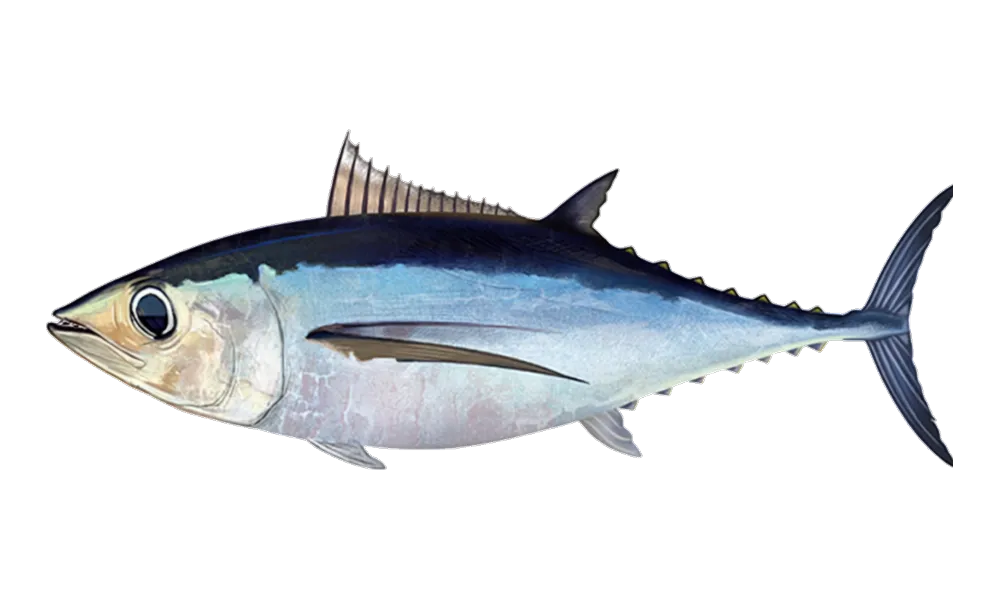
Albacore Thunnus alalunga
Typical: 26–34 in, 15–30 lb
Key field mark: Albacore's pectoral fins are exceptionally long (reaching past the second dorsal and anal fins) and the tail has a clean white trailing margin — both unique among the local tunas.
- Steel-blue back grading to dusky silver sides
- Extremely long pectoral fins reaching past the anal fin origin
- White trailing edge on the tail (caudal) fin
- Rounded football body with a relatively small second dorsal
- Finlets dusky/dark, not bright yellow
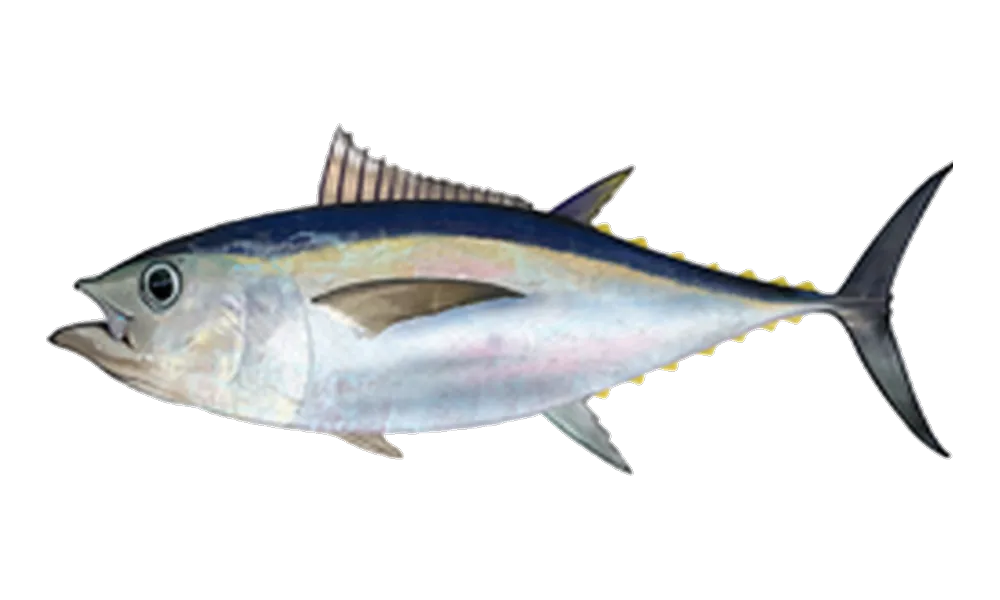
Bigeye Tuna Thunnus obesus
Typical: 40–60 in, 60–150 lb
Key field mark: A large eye plus a long pectoral fin AND short (un-elongated) second dorsal and anal fins separate bigeye from yellowfin; note the liver is SMOOTH (only bluefin has a striated liver), so dockside rely on the big eye and the long pectoral with short median fins.
- noticeably large eye
- very long pectoral fin (reaching past the second dorsal, especially in smaller fish)
- short second dorsal and anal fins (never elongated)
- dark metallic blue back, whitish belly
- bright yellow finlets edged in black
When Each Is Running October — current month highlighted
| Jan | Feb | Mar | Apr | May | Jun | Jul | Aug | Sep | Oct | Nov | Dec | |
|---|---|---|---|---|---|---|---|---|---|---|---|---|
| Albacore | ||||||||||||
| Bigeye Tuna |
Peak Good Fair Slow
Where Albacore and Bigeye Tuna Overlap
Both run in Southern California — that is where telling them apart actually matters.