 The Fishing Report
Fishing seasons & conditions by region
Amberjack Seriola dumerili
Amberjack Size, Range & Diet
| Typical size | 30–45 in, 15–40 lb |
|---|---|
| Maximum | up to 6 ft and nearly 200 lb |
| Lifespan | up to 17 years |
| Range | Western Atlantic from Nova Scotia to Brazil, but the fishery runs from the Carolinas south through Florida and the Keys and all across the Gulf of Mexico. |
| Habitat | Wrecks, rock ledges, towers and artificial reefs in roughly 60–240 ft, holding in the water column above the structure. |
| Diet | Reef baitfish, squid and crabs — a live blue runner or pinfish drifting over structure is exactly what they hunt. |
Sizes are typical rod-and-reel and documented maximum figures, not size limits — see the regulations links below for the rules where you fish.
How to Identify a Amberjack
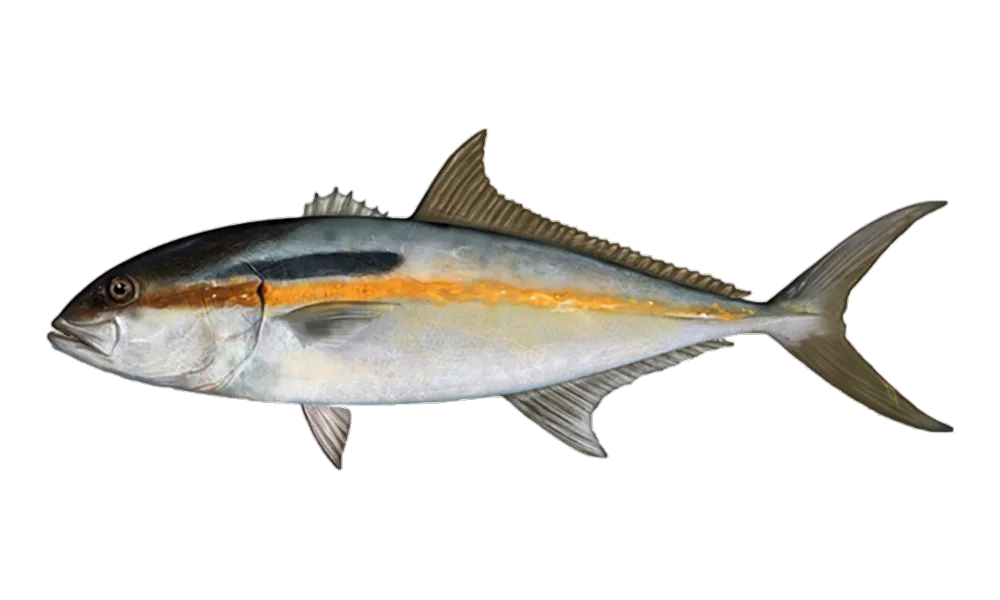
- Dark diagonal bar through the eye to the first dorsal ("bandit mask")
- Amber to brassy lateral stripe running along the flank
- Bronze-amber sides, long stout body
- Long-based second dorsal and anal fin
- Deeply forked tail; no barbel
Tell it apart: The dark diagonal eye-bar (nuchal bar) running up to the first dorsal, plus the amber flank stripe, identifies greater amberjack; cobia is flatter-headed with a dark side stripe and a row of separate dorsal spines.
Easily confused with: Cobia
Side by side: Amberjack vs Cobia
How to Catch Amberjack
Gear links open Amazon searches. As an Amazon Associate, The Fishing Report earns from qualifying purchases — at no extra cost to you. Using these links helps keep the site ad-free.
- Available year-round on deep wrecks and reefs; drop live baits or speed-jig vertical jigs straight down to hard-pulling schools.GearVertical speed jigs8/0 circle hooksHeavy jigging combo
- Available year-round on deep wrecks, reefs and rigs; drop live baits or speed-jig vertical jigs to hard-fighting schools.GearVertical speed jigs8/0 circle hooksHeavy jigging combo
- Wrecks, ledges and the shelf edge, best in the cooler months; drop a live blue runner or a heavy vertical jig to the top of the structure and be ready for them to run straight back down into it.GearVertical speed jigs8/0 circle hooksHeavy jigging combo
- Available year-round on deep wrecks and rigs when season allows; drop big live baits or heavy jigs to brutal-pulling schools.GearHeavy vertical jigs9/0 circle hooksHeavy jigging combo
When & Where Amberjack Are in Season
Peak Good Fair Slow
| Jan | Feb | Mar | Apr | May | Jun | Jul | Aug | Sep | Oct | Nov | Dec | |
|---|---|---|---|---|---|---|---|---|---|---|---|---|
| South Florida & the Keys Nearshore | ||||||||||||
| Gulf of Mexico Nearshore | ||||||||||||
| Puerto Rico & the U.S. Virgin Islands Nearshore | ||||||||||||
| Gulf of Mexico Offshore |
Amberjack Regulations
FloridaFlorida Fish and Wildlife Conservation Commission (FWC)South Atlantic Fishery Management CouncilSAFMCGulf of Mexico Fishery Management Council (Gulf Council)GMFMCAlabamaAlabama Department of Conservation and Natural Resources, Marine Resources Division (Outdoor Alabama)MississippiMississippi Department of Marine Resources (DMR)LouisianaLouisiana Department of Wildlife and Fisheries (LDWF)TexasTexas Parks & Wildlife Department (TPWD)Puerto RicoPuerto Rico Department of Natural and Environmental Resources (DRNA/DNER), Office of Forestry, Wildlife and Fisheries Licences and PermitsU.S. Virgin IslandsVirgin Islands Department of Planning and Natural Resources (DPNR), Division of Fish and WildlifeCaribbean Fishery Management CouncilCFMCNOAA Fisheries Southeast Region — current U.S. Caribbean regulationsNOAA Fisheries
Always check local regulations — seasons, size, and bag limits vary by state and species, and change year to year. When in doubt, release.