 The Fishing Report
Fishing seasons & conditions by region
Brown Trout vs Lake Trout
Two fish anglers routinely mix up. Here is what actually separates them — and when and where you are likely to meet each.
Side by Side
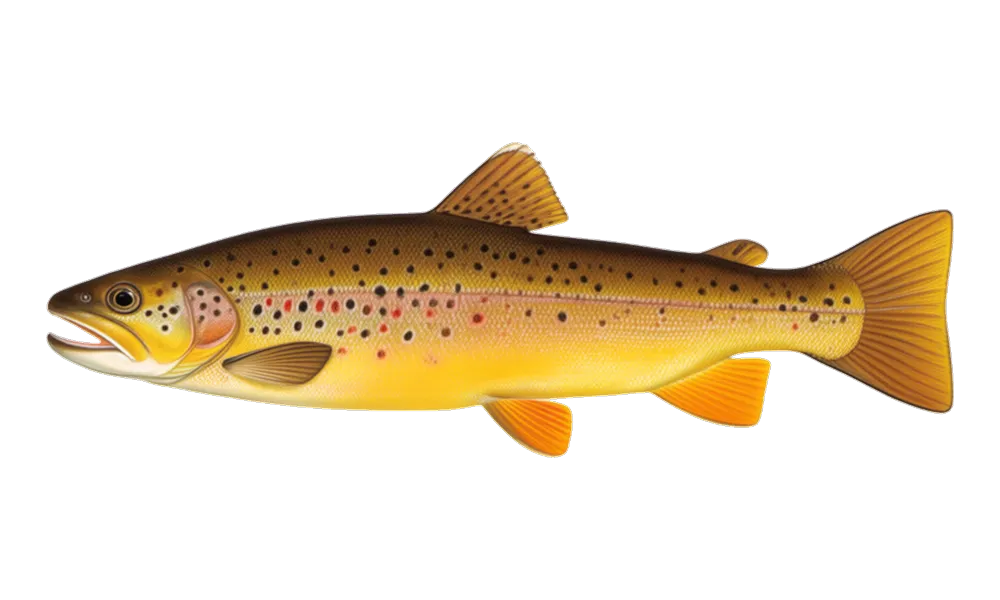
Brown Trout Salmo trutta
Typical: 16–26 in, 2–10 lb
Key field mark: Red-orange spots with pale halos and a nearly spotless tail mark a brown trout; steelhead and the salmon carry black-only spots and a clearly spotted tail.
- Buttery-brown to golden body
- Both black AND red/orange spots, many ringed with pale halos
- Few or no spots on the squared tail
- Adipose fin often tinged orange
- Sparse spotting below the lateral line
- Thick, blunt head
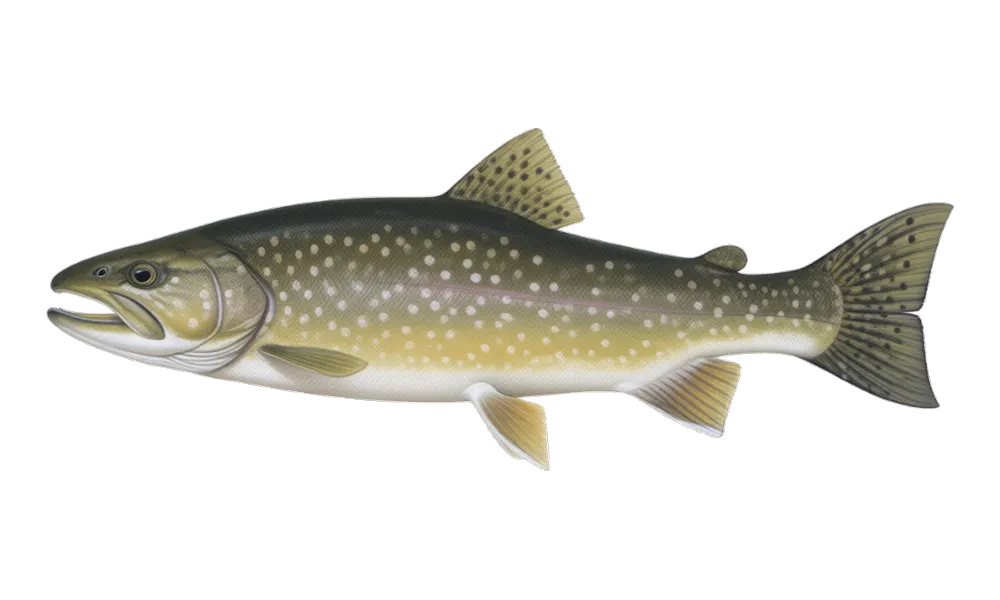
Lake Trout Salvelinus namaycush
Typical: 24–32 in, 5–15 lb
Quickest tell: A deeply forked tail with pale haloless spots on a dark body identifies lake trout; browns and steelhead have squared tails, and brown trout add red/orange haloed spots. (Worm-like vermiculations belong to brook trout, NOT lake trout.)
- Dark gray to gray-green body covered in pale cream spots
- Deeply forked tail (deepest fork of the region's salmonids)
- Pale spots without halos extend onto the forked tail
- White leading edge on the lower (pelvic, pectoral, anal) fins
- No pink stripe and no dark or red spots
- Spots may extend onto head, dorsal, and adipose
When Each Is Running October — current month highlighted
| Jan | Feb | Mar | Apr | May | Jun | Jul | Aug | Sep | Oct | Nov | Dec | |
|---|---|---|---|---|---|---|---|---|---|---|---|---|
| Brown Trout | ||||||||||||
| Lake Trout |
Peak Good Fair Slow
Where Brown Trout and Lake Trout Overlap
Both run in Great Lakes — that is where telling them apart actually matters.