 The Fishing Report
Canary / Vermilion Rock vs Yelloweye Rockfish
Two fish anglers routinely mix up. Here is what actually separates them — and when and where you are likely to meet each.
Side by Side
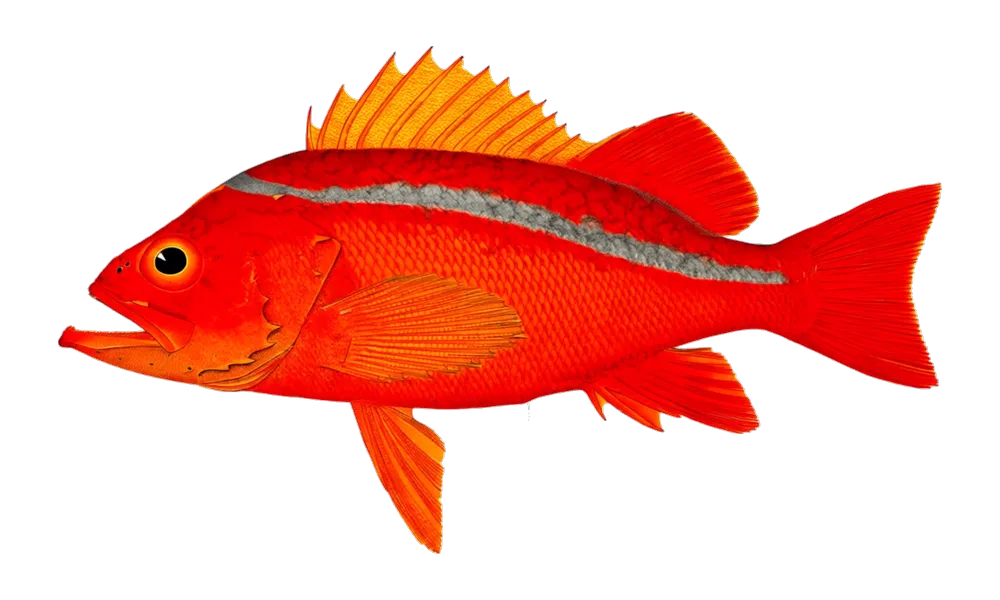
Canary / Vermilion Rock Sebastes pinniger
Typical: 14–24 in, 2–6 lb
Quickest tell: Run a finger along the lateral line: Canary shows a clear light-gray stripe right at the lateral line with 3 orange head bars, while Vermilion is more uniformly red with black fin edges; neither has Yelloweye's yellow eye or raspy eye ridges.
- Bright orange to red body; Canary is gray-mottled, Vermilion is more uniformly red
- Canary: 3 orange bars radiating across the head; lateral line runs in a clear gray zone
- Vermilion: black-edged fins, gray mottling on the back, rough scales
- Canary: fins all orange, anal fin slanting rearward
- Both have normal dark eyes (NOT the bright yellow of Yelloweye)
Full Canary / Vermilion Rock guide — season, gear and rules →
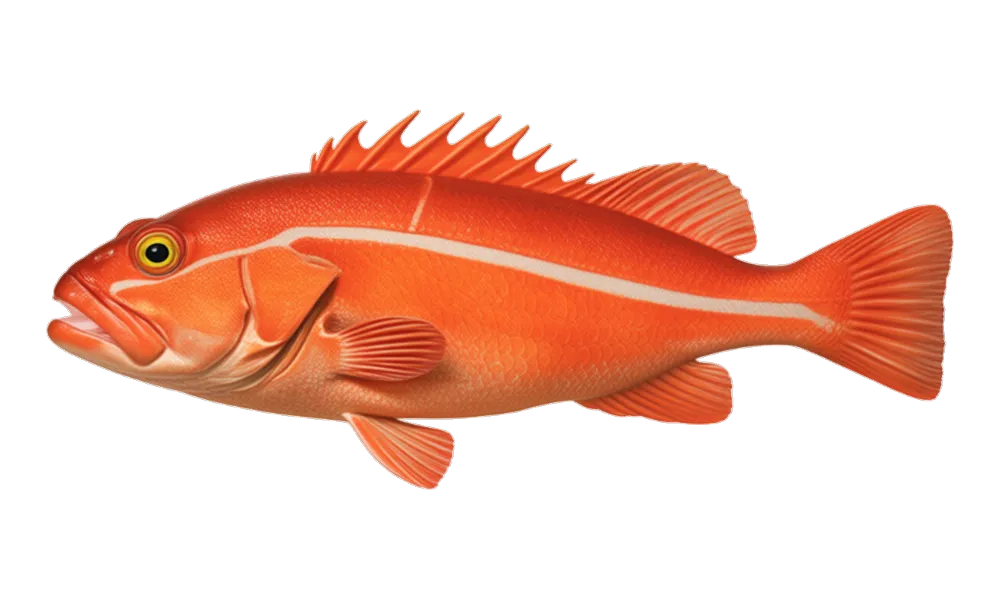
Yelloweye Rockfish Sebastes ruberrimus
Typical: 20–28 in, 5–12 lb
Quickest tell: The glowing yellow iris plus rough raspy bony ridges above the eyes confirm the protected Yelloweye (release required) over the similarly red canary (gray lateral stripe, smooth head) and vermilion (red iris, black-mottled body).
- Bright orange-red to yellow-orange body
- Brilliant YELLOW eye (iris)
- Rough, raspy bony ridges over and between the eyes
- Adults often show a pale lateral stripe; juveniles have two white stripes
- Large, deep body with a single strongly spined dorsal
When Each Is Running October — current month highlighted
| Jan | Feb | Mar | Apr | May | Jun | Jul | Aug | Sep | Oct | Nov | Dec | |
|---|---|---|---|---|---|---|---|---|---|---|---|---|
| Canary / Vermilion Rock | ||||||||||||
| Yelloweye Rockfish |
Where Canary / Vermilion Rock and Yelloweye Rockfish Overlap
Both run in Northern California, Pacific Northwest — that is where telling them apart actually matters.