 The Fishing Report
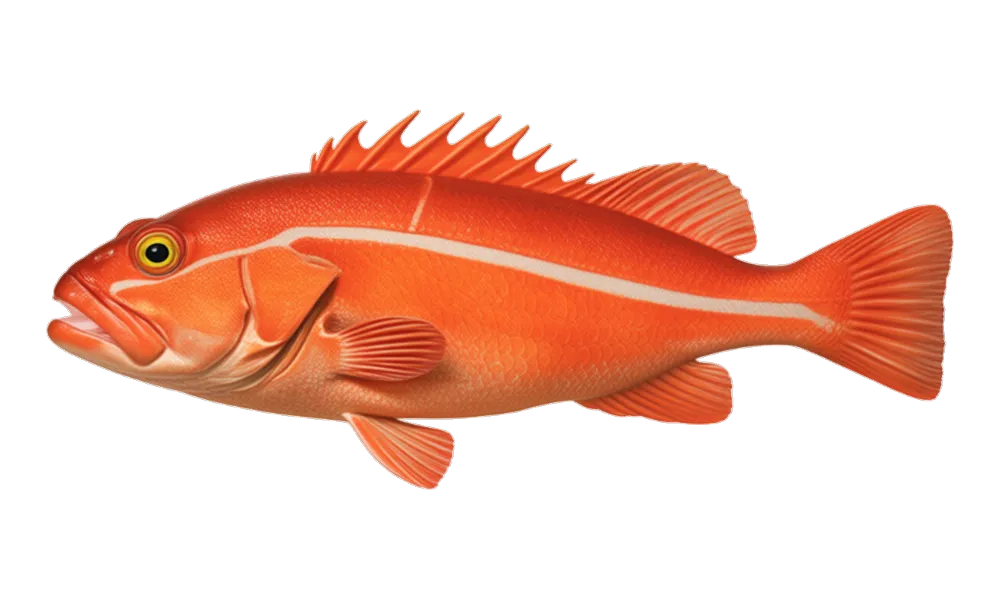
Yelloweye Rockfish Sebastes ruberrimus
Yelloweye Rockfish Size, Range & Diet
| Typical size | 20–28 in, 5–12 lb |
|---|---|
| Maximum | up to 3.5 ft and 40 lb |
| Lifespan | up to 150 years; the oldest aged in Alaska was 121 |
| Range | Cold rocky Pacific coast from the Aleutians and the Gulf of Alaska south through British Columbia, Washington and Oregon to northern California and Baja. |
| Habitat | Steep broken rock, pinnacles and sponge-covered walls, most often 300–600 ft down and rarely far from a crevice. |
| Diet | Small fish such as herring, sand lance and flatfish, plus crabs, snails and smaller rockfish taken near the bottom. |
Sizes are typical rod-and-reel and documented maximum figures, not size limits — see the regulations links below for the rules where you fish.
How to Identify a Yelloweye Rockfish
- Bright orange-red to yellow-orange body
- Brilliant YELLOW eye (iris)
- Rough, raspy bony ridges over and between the eyes
- Adults often show a pale lateral stripe; juveniles have two white stripes
- Large, deep body with a single strongly spined dorsal
Tell it apart: The glowing yellow iris plus rough raspy bony ridges above the eyes confirm the protected Yelloweye (release required) over the similarly red canary (gray lateral stripe, smooth head) and vermilion (red iris, black-mottled body).
Easily confused with: Canary / Widow Rockfish, Shelf Rockfish
Side by side: Yelloweye Rockfish vs Black Rockfish, Yelloweye Rockfish vs Canary / Vermilion Rock, Yelloweye Rockfish vs Shelf Rockfish
How to Catch Yelloweye Rockfish
Gear links open Amazon searches. As an Amazon Associate, The Fishing Report earns from qualifying purchases — at no extra cost to you. Using these links helps keep the site ad-free.
- Best summer, June through September, but tightly regulated — when legal, drop bait rigs onto deep rock; otherwise expect to release them.GearDeep-drop bait rigsDescending release deviceHeavy bottom combo
- Available May through October but tightly regulated — when legal, drop bait rigs onto deep rock; otherwise release fish with a descending device.GearDeep-drop bait rigsDescending release deviceHeavy bottom combo
- Catchable May-September over deep rocky reefs; drop heavy jigs and bait rigs to the bottom, and use a descending device to release fish unharmed.GearHeavy rockfish jigsShrimp fly rigsDescending device
- Deep on the same structure as the blacks; drop heavy jigs and bait rigs to the bottom and carry a descending device to release fish unharmed.GearHeavy rockfish jigsShrimp fly rigsDescending device
When & Where Yelloweye Rockfish Are in Season
| Jan | Feb | Mar | Apr | May | Jun | Jul | Aug | Sep | Oct | Nov | Dec | |
|---|---|---|---|---|---|---|---|---|---|---|---|---|
| Northern California Offshore | ||||||||||||
| Pacific Northwest Offshore | ||||||||||||
| Alaska — Southcentral & Southeast Nearshore | ||||||||||||
| Alaska — Southcentral & Southeast Offshore | ||||||||||||
| Alaska — Aleutians & Alaska Peninsula Offshore |