 The Fishing Report
Alaska — Southcentral & Southeast — Fishing Seasons & Conditions
Remote cold-water fisheries with 20-foot tidal swings, 100-pound halibut, and five salmon species on a compressed May–September open-water calendar.
The AI First Mate’s Read — Monday, October 19
Southcentral and Southeast Alaska anglers face a rollercoaster over the next few days. Monday starts manageable with two-foot seas and light winds, though rain is likely. Tuesday brings the roughest conditions with seas building to four feet and gusts near twenty knots, so plan accordingly if you're heading out. Halibut and rockfish remain solid targets when conditions allow. Wednesday settles back down with two-foot seas returning, though it'll be colder with less than half the rain chance of the previous days. The window between Monday morning and Wednesday afternoon offers your best shot at Pacific cod and yelloweye rockfish before the midweek blow.
Our AI first mate reads the live NOAA forecast and this region’s season calendar every morning and writes this up — it covers the next few days. Conditions shift; check the live report before you go.
Alaska — Southcentral & Southeast: What’s Biting in October 2026
Biting right now — 4 species are worth targeting in October here.
Tap any species for how to identify it, when it runs and what to throw. This is when the fish are active here — check the regulations below before you keep anything.
What's Biting — Month by Month October — current month highlighted
Harbors, Bays & Tributaries
| Jan | Feb | Mar | Apr | May | Jun | Jul | Aug | Sep | Oct | Nov | Dec | |
|---|---|---|---|---|---|---|---|---|---|---|---|---|
| Chinook / King Salmon | ||||||||||||
| Coho / Silver Salmon | ||||||||||||
| Pink Salmon | ||||||||||||
| Chum Salmon | ||||||||||||
| Sockeye Salmon | ||||||||||||
| Pacific Cod |
Nearshore & Reefs
| Jan | Feb | Mar | Apr | May | Jun | Jul | Aug | Sep | Oct | Nov | Dec | |
|---|---|---|---|---|---|---|---|---|---|---|---|---|
| Pacific Halibut | ||||||||||||
| Lingcod | ||||||||||||
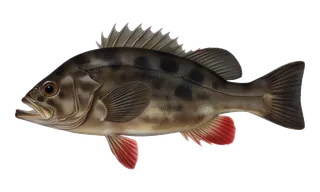
| Yelloweye Rockfish | ||||||||||||
| Black/Dusky Rockfish | ||||||||||||
| Chinook / King Salmon | ||||||||||||
| Coho / Silver Salmon |
Open Water / Offshore Banks
| Jan | Feb | Mar | Apr | May | Jun | Jul | Aug | Sep | Oct | Nov | Dec | |
|---|---|---|---|---|---|---|---|---|---|---|---|---|
| Pacific Halibut | ||||||||||||
| Pacific Cod | ||||||||||||
| Chinook / King Salmon | ||||||||||||
| Coho / Silver Salmon | ||||||||||||
| Lingcod | ||||||||||||
| Yelloweye Rockfish |
What to Target & How
Gear links open Amazon searches. As an Amazon Associate, The Fishing Report earns from qualifying purchases — at no extra cost to you. Using these links helps keep the site ad-free.
Inshore
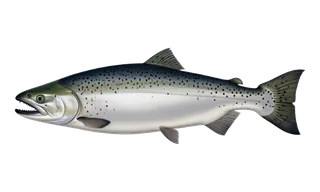 Chinook / King Salmon — Tight summer run peaking June-July; troll cut-plug herring and flashers on downriggers in salt, or drift bobber-and-yarn and spoons through holding river holes.GearCut-plug herring rigTrolling flashersSalmon mooching rod
How to ID
- Black gums/gumline at base of teeth on lower jaw (mouth interior also dark)
- Irregular black spots on the back AND on BOTH lobes of the tail
- Silver body, blue-green back; large, robust, deep-bodied
- Spots present on entire caudal fin, not just the upper lobe
Typical: 24–36 in, 15–30 lb
Tell it apart: Black gumline along the lower jaw PLUS spots covering both tail lobes separate a king from a coho's pale/white gums and upper-lobe-only tail spotting. Don't rely on size or fin-ray counts alone.
Easily confused with: Coho / Silver Salmon
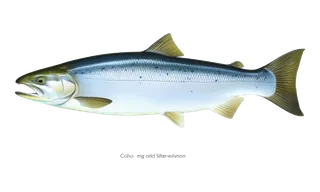 Coho / Silver Salmon — Best August-September; cast bright spoons and spinners at river mouths and troll herring in salt water, with aggressive coho hammering flashy hardware.GearCasting spoonsInline spinnersSalmon spinning combo
How to ID
- Black mouth interior but WHITE/gray gums at base of teeth on lower jaw
- Spots on back and on the UPPER tail lobe only (lower lobe usually clean)
- Bright silver sides, blue back; broad caudal peduncle
- Moderately forked tail
Typical: 24–30 in, 8–12 lb
Tell it apart: White/gray gums (against the black mouth) with spots confined to the upper tail lobe mark a coho versus the king's black gumline and fully spotted tail.
Easily confused with: Chinook / King Salmon
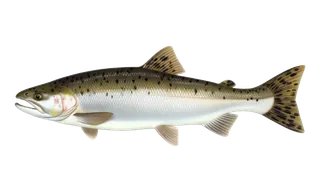 Pink Salmon — Concentrated July-August on its two-year run; cast small pink spoons, spinners and jigs at river mouths and tide rips where dense schools stage.GearPink casting spoonsSmall pink jigsLight salmon combo
How to ID
- Large oval/oblong black blotches over the entire tail AND on the back
- Very small scales (smallest of any Pacific salmon)
- Bright silver at sea; smallest, most slender Pacific salmon
- Spawning males develop a pronounced humped back
Typical: 18–25 in, 3–5 lb
Tell it apart: Big oval spots covering the WHOLE tail plus the tiniest scales of any salmon clinch a pink; coho spot only the upper lobe and chum has no real spots.
Easily confused with: Coho / Silver Salmon, Chum Salmon
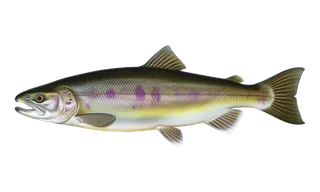 Chum Salmon — Runs July-August; cast chartreuse and green spoons, spinners and yarn flies in tidewater and lower rivers, where hard-fighting chum take swung hardware.GearBright casting spoonsInline spinnersYarn flies
How to ID
- No distinct spots on back or tail
- Silver at sea; spawners show purple/green vertical 'calico' bars
- Whitish tips on anal and pelvic fins
- Narrow caudal peduncle (thin tail base)
- Large, often white-rimmed pupil/eye
Typical: 24–28 in, 8–15 lb
Tell it apart: A spotless back and tail combined with a thin caudal peduncle and white-tipped anal/pelvic fins separate chum from spotted pinks/coho and from spotless sockeye (use gill-raker count to split chum from sockeye).
Easily confused with: Sockeye Salmon, Pink Salmon, Coho / Silver Salmon
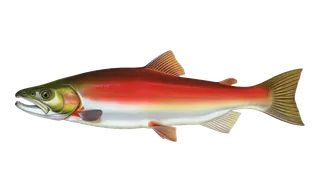 Sockeye Salmon — Sharp June-July run; flip-and-drift weighted sparse flies and yarn on short leaders, lining mouths of densely packed fish in clear river current.GearSockeye fliesBead and yarn rigsDrift fishing rod
How to ID
- No spots on back or tail
- Bright silver body at sea, greenish-blue back; prominent glassy eye
- Many long, fine, serrated and closely spaced gill rakers on the first arch (over 30–40)
- Spawners turn bright red with a green head
Typical: 22–28 in, 4–8 lb
Tell it apart: Spotless body plus numerous long, fine, closely set gill rakers (count them on the first arch — far more than chum's short, sparse rakers) confirm a sockeye.
Easily confused with: Chum Salmon, Pink Salmon, Coho / Silver Salmon
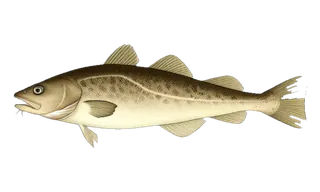 Pacific Cod — Available May-August inshore over rocky bottom; drop large jigs and herring on heavy bait rigs, working structure where cod hold near the seafloor.GearHeavy bottom jigsShrimp fly bait rigsBottomfish rod combo
How to ID
- Single long chin barbel (whisker) at least as long as eye diameter
- Three separate dorsal fins and two anal fins
- Brown/gray mottled body, pale belly
- Pale, curved lateral line
- Rounded/square tail, blunt snout
Typical: 20–32 in, 5–15 lb
Tell it apart: The single fleshy chin barbel and three separate dorsal fins are unique among Alaska bottomfish and immediately separate cod from the barbel-less, single-dorsal lingcod.
Easily confused with: Lingcod
Nearshore
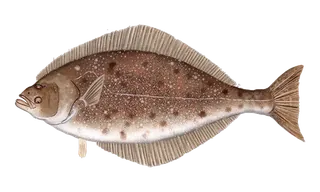 Pacific Halibut — Prime May-September; anchor or drift over sandy bottom dropping large circle hooks baited with herring or salmon, and big leadhead jigs and swimbaits.GearHeavy circle hooksLarge leadhead jigsHalibut rod combo
How to ID
- Both eyes on the right (dark, upper) side; right-eyed flatfish
- Large diamond/oval flat body, lies on its side
- Dark brown/mottled top side, white underside
- Large mouth reaching to the eye; strongly forked (lunate) tail
- Lateral line arches high over the pectoral fin
Typical: 30–45 in, 12–40 lb
Tell it apart: A large right-eyed flatfish with a strongly forked tail and white underside is a halibut, not an arrowtooth flounder (slimmer, large-mouthed, nearly straight tail) — confirm the forked tail and arched lateral line.
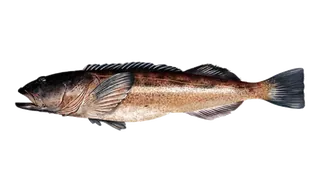 Lingcod — Best July-August once seasons open; drop heavy jigs and swimbaits onto rocky pinnacles and reefs, where aggressive lingcod ambush from cover.GearHeavy leadhead jigsLarge swimbaitsHeavy jigging rod
How to ID
- Large mouth packed with numerous large, sharp canine-like teeth
- Single long continuous dorsal fin with a notch between spiny and soft portions
- Mottled brown/gray/green body; flesh sometimes blue-green
- No chin barbel
- Elongated body; a cirrus (flap) above each eye
Typical: 24–36 in, 5–20 lb
Tell it apart: A toothy, barbel-less mouth and a single long notched dorsal fin distinguish lingcod from the smooth-mouthed, barbeled, three-dorsal Pacific cod.
Easily confused with: Pacific Cod
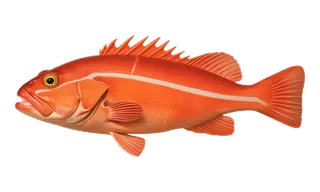 Yelloweye Rockfish — Catchable May-September over deep rocky reefs; drop heavy jigs and bait rigs to the bottom, and use a descending device to release fish unharmed.GearHeavy rockfish jigsShrimp fly rigsDescending device
How to ID
- Bright orange to orange-red body (adults)
- Brilliant yellow eyes
- Raspy/rough bony ridges over and behind the eyes
- Juveniles have one or two pale/white horizontal stripes along the body
- Heavy body, strong dorsal and anal fin spines
Typical: 20–28 in, 5–12 lb
Tell it apart: Orange-red body with vivid yellow eyes and rough bony ridges over the eyes positively IDs a yelloweye (locally 'red snapper') — its bright color alone separates it from the dark black/dusky rockfishes.
Easily confused with: Black/Dusky Rockfish
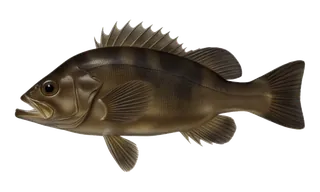 Black/Dusky Rockfish — Best May-September around nearshore pinnacles; cast and jig swimbaits and shrimp flies near the surface and mid-column where schooling rockfish suspend.GearSoft swimbaitsShrimp fly rigsMedium jigging combo
How to ID
- Dark gray to black (black rockfish) or olive/brown-gray (dusky)
- Spiny dorsal fin: black rockfish ~13 spines, dusky ~14
- Black rockfish: dark spots/blotches on the spiny dorsal fin; dusky plainer
- Black rockfish anal fin trailing edge ROUNDED; dusky SLANTED/straight
- Heavy-bodied schooling rockfishes; large mouth
Typical: 14–20 in, 2–5 lb
Tell it apart: Both are dark schooling rockfish; the trailing edge of the anal fin separates them — ROUNDED in black rockfish, SLANTED/straight in dusky.
Easily confused with: Yelloweye Rockfish
Fishing Regulations
Tides & Timing
Read the Tide
Alaska's tidal swings of 15–20 feet make tide the single most important variable — halibut and lingcod bite best on the first push of moving water after slack, salmon push into bays hardest on the incoming tide, and trying to anchor or drift in peak tidal flow in constricted passes is dangerous for a small boat.
Alaska — Southcentral & Southeast Fishing Towns
Per-town fishing reports — local spots and launches inside this region.