 The Fishing Report
Mid-Atlantic — Fishing Seasons & Conditions
From the Chesapeake mouth and Delmarva peninsula to the NY Bight — canyons offshore, striper runs inshore, and a cobia migration that's almost a religious event.
The AI First Mate’s Read — Monday, October 19
Strong winds and elevated seas dominate the next few days along the Mid-Atlantic coast. Expect 11-foot seas with winds gusting to 34 knots Monday through Wednesday, making conditions challenging for most anglers. If you can get out, striped bass and bluefish are your best bets inshore, though rough conditions will limit access. Offshore, yellowfin and bigeye tuna are in the mix for boats willing to venture out in these seas. Black sea bass and summer flounder remain solid options when conditions allow. Rain chances stay low, but the wind-driven seas are the real story—best to monitor conditions closely before heading out.
Our AI first mate reads the live NOAA forecast and this region’s season calendar every morning and writes this up — it covers the next few days. Conditions shift; check the live report before you go.
Mid-Atlantic: What’s Biting in October 2026
Biting right now — 15 species are worth targeting in October here, and the 7 marked Peak are at their best right now.
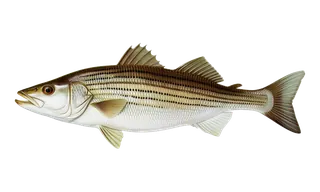 Striped BassPeak
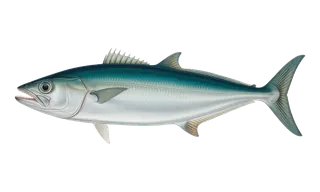 BluefishPeak
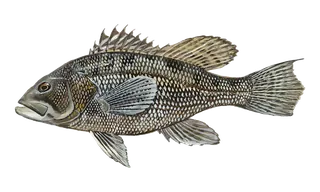 Black Sea BassPeak
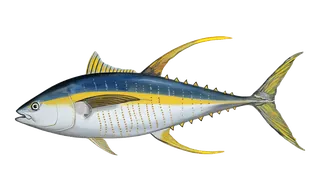 Yellowfin TunaPeak
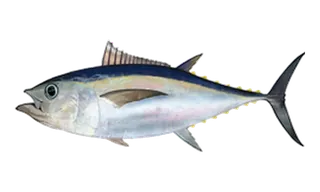 Bigeye TunaPeak
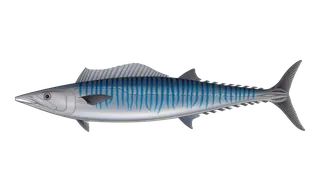 WahooPeak
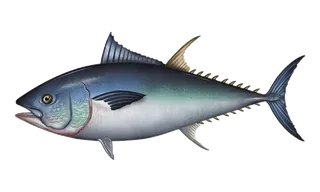 Bluefin TunaPeak
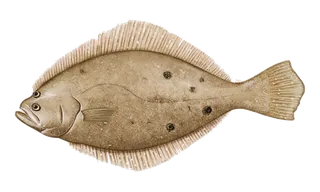 Summer Flounder
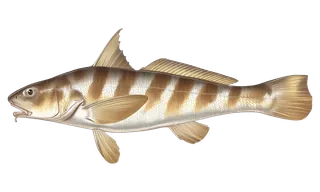 Whiting (Kingfish)
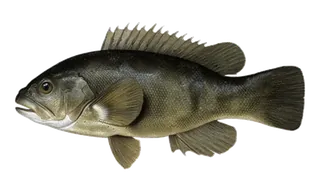 Tautog
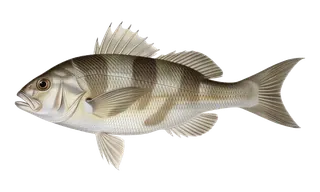 Scup / Porgy
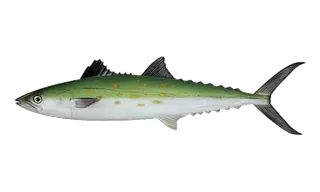 Spanish Mackerel
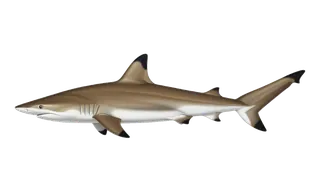 Sharks
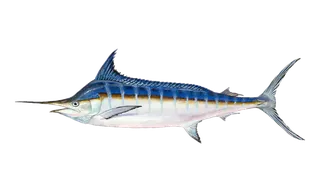 Blue Marlin
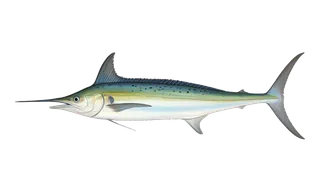 White Marlin
Tap any species for how to identify it, when it runs and what to throw. This is when the fish are active here — check the regulations below before you keep anything.
What's Biting — Month by Month October — current month highlighted
Inshore — Chesapeake Bay, inlets, surf
| Jan | Feb | Mar | Apr | May | Jun | Jul | Aug | Sep | Oct | Nov | Dec | |
|---|---|---|---|---|---|---|---|---|---|---|---|---|
| Striped Bass | ||||||||||||
| Summer Flounder | ||||||||||||
| Weakfish | ||||||||||||
| Bluefish | ||||||||||||
| Sheepshead | ||||||||||||
| Whiting (Kingfish) | ||||||||||||
| Tautog |
Nearshore — Beach to 30 mi
| Jan | Feb | Mar | Apr | May | Jun | Jul | Aug | Sep | Oct | Nov | Dec | |
|---|---|---|---|---|---|---|---|---|---|---|---|---|
| Cobia | ||||||||||||
| Black Sea Bass | ||||||||||||
| Scup / Porgy | ||||||||||||
| Spanish Mackerel | ||||||||||||
| Sharks | ||||||||||||
| Bluefish (offshore) |
Offshore — Canyons, shelf edge
| Jan | Feb | Mar | Apr | May | Jun | Jul | Aug | Sep | Oct | Nov | Dec | |
|---|---|---|---|---|---|---|---|---|---|---|---|---|
| Yellowfin Tuna | ||||||||||||
| Bigeye Tuna | ||||||||||||
| Mahi (Dolphin) | ||||||||||||
| Wahoo | ||||||||||||
| Blue Marlin | ||||||||||||
| White Marlin | ||||||||||||
| Bluefin Tuna |
What to Target & How
Gear links open Amazon searches. As an Amazon Associate, The Fishing Report earns from qualifying purchases — at no extra cost to you. Using these links helps keep the site ad-free.
Inshore
- Striped Bass — Best in the spring run (Apr-May) and fall blitz (Oct-Nov) - cast swimming plugs and bucktails to migrating schools; livelining bunker or eels works through summer.GearSwimming plugsBucktail jigsSurf casting rod
How to ID
- 7-8 dark, unbroken horizontal stripes on silvery flanks
- stripes run continuous from gill cover to tail base
- two clearly separate dorsal fins, front one spiny
- olive-green to blue-gray back, white belly
- stout, slightly arched body with a long head
Typical: 20–36 in, 4–20 lb
Tell it apart: Clean, continuous, straight horizontal stripes (not broken, wavy, or staggered) over a silvery body confirm it, and the front spiny dorsal stands fully separate from the soft rear dorsal.
- Summer Flounder — Peaks June-September - drift sandy channels and inlets bouncing a bucktail tipped with Gulp or a squid-and-minnow rig along the bottom.GearBucktail jigsGulp swimming mulletFlounder rigs
How to ID
- left-eyed: both eyes on the left side when the dark (eyed) side faces up
- 5 prominent ocellated (dark-ringed) eyespots arranged in an X, plus smaller scattered spots
- large mouth, sharp teeth, gape reaching to or past the rear of the eye
- mottled brown eyed-side, plain white blind side
- broad oval body with a long continuous dorsal fin
Typical: 15–22 in, 1–4 lb
Tell it apart: With the dark side up and the dorsal fin away from you, the eyes sit on the LEFT and the mouth is large and toothy, the gape reaching past the eye, separating fluke from the smaller, right-eyed, tiny-mouthed winter flounder.
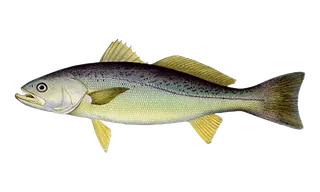 Weakfish — Best May-August in back bays and rips - drift bloodworm-baited rigs or work soft-plastic shads slowly near the bottom at dawn and dusk.GearSoft-plastic shadLead jigheadsBloodworm rigs
How to ID
- iridescent purple-green back with small dark spots in oblique wavy rows
- yellowish fins, especially the pelvic and anal fins
- two prominent canine fangs at the tip of the upper jaw
- no chin barbels
- no black spot at the tail base or along the lateral line
Typical: 12–20 in, 1–4 lb
Tell it apart: The pair of large canine fangs at the front of the upper jaw, the wavy rows of small spots (never the clean horizontal stripes of a striped bass), and the soft, easily-torn mouth (hence 'weakfish') are diagnostic.
Easily confused with: Striped Bass
- Bluefish — Strong May through October - cast metal-lip plugs and poppers into surface blitzes or troll spoons, always using a wire bite leader.GearSurface poppersDiamond jigsWire leader rigs
How to ID
- blue-green back fading to silvery sides
- mouth full of prominent, sharp, flat triangular teeth
- moderately forked tail
- dusky blotch at the base of the pectoral fin
- two dorsal fins, the soft rear one long and low
Typical: 14–26 in, 1–7 lb
Tell it apart: The single row of large, flat, razor-sharp triangular teeth in a heavy lower jaw is unmistakable and separates it from the small needle-toothed Spanish mackerel, which also wears gold spots a bluefish never has.
Easily confused with: Spanish Mackerel
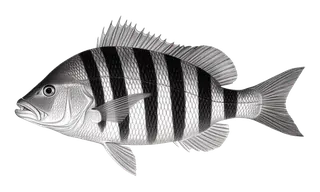 Sheepshead — Best in the cooler months (Nov-Apr) around bridge pilings and jetties - drop fiddler crab or sand flea on a small knocker rig tight to structure.GearSheepshead jigsLive-bait hooksKnocker rig sinkers
How to ID
- 5-7 bold black vertical bars on a silvery-gray body
- protruding, flat, human-like incisor teeth at the front of the mouth
- deep, compressed (high-bodied) profile
- stout sharp spines on the dorsal and anal fins
- steep, blunt forehead, no barbels
Typical: 14–18 in, 2–5 lb
Tell it apart: The protruding flat human-like front teeth plus bold black vertical bars are diagnostic; scup share the deep silvery compressed body but have a tiny blunt mouth with no incisors and lack the heavy vertical bars.
Easily confused with: Scup / Porgy
- Whiting (Kingfish) — A Mid-Atlantic summer visitor, late spring through October — small bits of bloodworm, clam or Fishbites on a two-hook high-low rig dropped into the sloughs and cuts between the bars.GearHigh-low surf rigsBloodworm FishbitesSize 4–6 baitholder hooks
How to ID
- Long, round-bodied silver fish with a flat belly and a small underslung mouth
- ONE short stiff barbel under the tip of the lower jaw
- Grayish-brown to bronze back fading to silvery sides and a white belly
- Southern kingfish: 7–8 soft-edged dark diagonal blotches along the side, parallel — never meeting in a V
- Gulf kingfish: plain silver with no bars and a blackish tip on the tail
- Northern kingfish: bold oblique bars, two of them forming a V behind the head, and a long trailing spine on the first dorsal fin
Typical: 10–14 in, 0.5–1.5 lb
Tell it apart: One short barbel under the tip of the lower jaw marks a whiting; the tail then says which one — plain silver with a black-tipped tail is Gulf kingfish, parallel diagonal blotches is southern, and bars meeting in a V behind the head is northern.
- Tautog — Peaks in April and again October-November - anchor over wrecks and rocks and drop green or fiddler crab on a tog rig tight to structure.GearTog jigsTautog rigsConventional jigging rod
How to ID
- blunt, rounded head with thick rubbery lips
- mottled dark gray to blackish-green, blotchy sides
- stout, deep body with thick leathery, slimy skin
- white chin patch on large males
- powerful jaws with crushing molar-like teeth set back in the mouth
Typical: 14–20 in, 2–5 lb
Tell it apart: The blunt rubbery-lipped head, thick leathery skin, and uniform blotchy dark coloring (no white-spotted fin rows, no trailing tail filament) separate tautog from the lighter, spinier black sea bass.
Easily confused with: Black Sea Bass
Nearshore
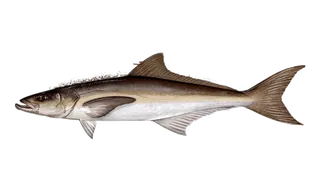 Cobia — A brief late-spring to early-summer window (May-Aug) - sight-cast a bucktail or eel to fish cruising buoys, rays and the surface.GearHeavy bucktail jigsSoft-plastic eelsCircle hooks
How to ID
- long, dark-brown torpedo body with a broad black lateral band (boldest in juveniles)
- flat, broad, depressed head with a projecting lower jaw
- first dorsal reduced to 7-9 short, stiff, isolated spines
- white belly, sometimes a second pale stripe below the dark band
- broad, forked tail (lunate in adults)
Typical: 30–45 in, 15–40 lb
Tell it apart: The row of short, separate, stiff isolated spines just ahead of the soft dorsal, plus the shark-like flat head and dark lateral band, positively ID cobia; a remora (its closest look-alike) instead carries a flat sucking disc on its head and no free spines.
Easily confused with: Sharks
- Black Sea Bass — Best May through October - drop squid strips or clam on a high-low rig over wrecks and rockpiles, or jig with a teaser dropper.GearDiamond jigsHigh-low rigsBottom fishing rod
How to ID
- stocky body, smoky gray to blue-black, often with light spots and lines in rows along the fins
- single long dorsal fin with stout sharp spines
- rounded fins, the dorsal with pale spots/streaks
- elongated top tail-fin ray (filament) trailing on large fish
- fleshy nuchal hump, often bluish, on big spawning males
Typical: 11–17 in, 1–3 lb
Tell it apart: The long single spiny dorsal with rows of white spots, plus the trailing top tail-ray filament (and bluish nuchal hump) on adults, separate it from the blunt rubbery-lipped tautog and the deeper-bodied, smaller-mouthed scup.
Easily confused with: Tautog, Scup / Porgy
- Scup / Porgy — Peaks June-September - anchor over rocky bottom and fish small hooks baited with clam or squid on a simple two-hook bottom rig.GearPorgy hooksTwo-hook bottom rigsBank sinkers
How to ID
- deep, compressed silvery body, sometimes with faint dusky bars
- small mouth, blunt snout, no canine or incisor teeth (rows of small teeth only)
- single dorsal fin with sharp spines
- slightly forked tail
- iridescent silvery flanks, sometimes dusky-blotched
Typical: 8–14 in, 0.5–2 lb
Tell it apart: The deep silvery oval body with a tiny blunt mouth and no fangs or incisors marks a scup; black sea bass is darker, longer-bodied, and shows white-spotted fin rows, while sheepshead wears bold black bars and protruding front teeth.
Easily confused with: Black Sea Bass, Sheepshead
- Spanish Mackerel — Best June-September - troll or cast small fast-moving Clark spoons and metal jigs through diving birds on light wire or long fluoro leader.GearClark spoonsCasting metal jigsFluorocarbon leader
How to ID
- green-blue back with rows of golden-yellow oval spots scattered onto the sides
- prominent black blotch on the front (anterior) third of the first dorsal fin
- sleek streamlined body with a deeply forked tail
- small, sharp, needle-like teeth
- row of small finlets behind the dorsal and anal fins
Typical: 14–22 in, 1–3 lb
Tell it apart: Scattered round gold spots (no bars, no stripes) plus the distinct black blotch on the front of the first dorsal fin ID Spanish mackerel; bluefish lack the gold spots and carry large flat triangular teeth instead of fine needle teeth.
Easily confused with: Bluefish
- Sharks — Best June through September - drift a chum slick and float oily cut bunker or mackerel baits on a wire or cable leader at varied depths.GearHeavy circle hooksCable leader rigsStand-up shark combo
How to ID
- cartilaginous body with 5 exposed gill slits and no bony gill cover
- heterocercal tail (upper lobe distinctly longer than the lower)
- rough sandpaper skin from dermal denticles
- snout shape and tooth form vary by species
- rigid, low-set pectoral fins that do not fold against the body
Typical: 2.5–6 ft, 10–90 lb
Tell it apart: Any fish with exposed gill slits (no gill cover) and a longer upper tail lobe is a shark, not the flat-headed cobia it is sometimes mistaken for; tell common Mid-Atlantic species apart by snout and teeth: sandbar/dusky have a tall first dorsal set well forward, sand tiger shows snaggly protruding teeth, and spinner/blacktip have black-tipped fins.
Easily confused with: Cobia
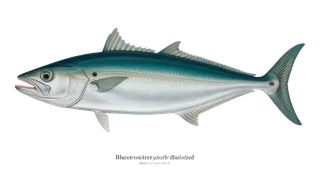 Bluefish (offshore) — Best May-October - troll spoons and umbrella rigs along nearshore lumps and rips, or chunk bunker over structure for bigger choppers.GearTrolling spoonsUmbrella rigsWire trolling leader
How to ID
- blue-green back, silvery sides (same species as inshore bluefish)
- heavy lower jaw packed with large, flat, triangular razor teeth
- moderately forked tail
- dusky spot at the base of the pectoral fin
- larger, heavier-shouldered 'gator'/'chopper' class size offshore
Typical: 24–34 in, 6–15 lb
Tell it apart: Identical to inshore bluefish, so the heavy lower jaw of flat triangular teeth confirms it (and rules out the needle-toothed, gold-spotted Spanish mackerel); the only difference offshore is the larger 'gator' size class.
Easily confused with: Spanish Mackerel
Offshore
- Yellowfin Tuna — Best July through October at the canyons - troll spreader bars and ballyhoo by day, then chunk butterfish on the anchor overnight.GearSpreader barsBallyhoo rigsOffshore trolling combo
How to ID
- greatly elongated, sickle-shaped, bright-yellow second dorsal and anal fins on adults
- bright yellow finlets edged in black along the back and belly
- dark blue back, silver sides, a golden-yellow lateral stripe
- white spots and wavy lines on the lower belly
- moderately short pectoral fin (reaching about to the second dorsal)
Typical: 36–50 in, 30–80 lb
Tell it apart: The greatly elongated bright-yellow second dorsal and anal fins (long curved sickles on adults) separate yellowfin from bigeye and bluefin, which both keep those fins short; the yellow lateral stripe and finlets reinforce the call.
Easily confused with: Bigeye Tuna, Bluefin Tuna
- Bigeye Tuna — Best August-October in the canyons - troll dark spreader bars and large ballyhoo at first and last light, or deep-jig over structure.GearSpreader barsSpeed jigsHeavy trolling combo
How to ID
- noticeably large eye
- very long pectoral fin (reaching past the second dorsal, especially in smaller fish)
- short second dorsal and anal fins (never elongated)
- dark metallic blue back, whitish belly
- bright yellow finlets edged in black
Typical: 40–60 in, 60–150 lb
Tell it apart: A large eye plus a long pectoral fin AND short (un-elongated) second dorsal and anal fins separate bigeye from yellowfin; note the liver is SMOOTH (only bluefin has a striated liver), so dockside rely on the big eye and the long pectoral with short median fins.
Easily confused with: Yellowfin Tuna, Bluefin Tuna
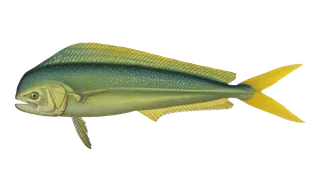 Mahi (Dolphin) — Best June-August - troll skirted ballyhoo near lobster pots and weedlines, then pitch bucktails or cut bait to the schooling fish.GearSkirted trolling luresBallyhoo rigsCasting bucktails
How to ID
- brilliant blue-green-and-gold body, electric color that fades fast after death
- blunt, square forehead (very steep and high in mature 'bull' males)
- single long dorsal fin running nearly the entire length of the back
- scattered dark spots on the sides
- deeply forked, yellow tail
Typical: 24–40 in, 5–25 lb
Tell it apart: The single full-length dorsal fin, the blunt high forehead, and the electric blue-green-gold flash are unmistakable; nothing else in the region looks like it.
- Wahoo — Best September-October - high-speed troll weighted Ilander-style heads and bullet lures on wire leader along temperature breaks and canyon edges.GearIlander-style luresSingle-strand wire leaderOffshore trolling combo
How to ID
- long, slender, steel-blue body with 25-30 vertical cobalt 'tiger' bars
- pointed, beak-like snout with a mouth of sharp, blade-like teeth
- long, low single dorsal fin
- row of finlets toward the tail
- deeply forked tail, extremely streamlined
Typical: 40–60 in, 20–50 lb
Tell it apart: The very long slim body with 25-30 vertical electric-blue bars and a sharp beak-like snout full of blade teeth IDs wahoo; Spanish mackerel are far smaller and wear round gold spots, never vertical bars.
Easily confused with: Spanish Mackerel
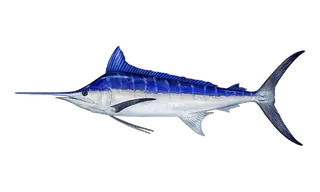 Blue Marlin — Best July-September at the canyons - troll a spread of large skirted lures and horse-ballyhoo at 7-9 kt along blue-water edges.GearBig-game trolling luresHeavy mono leaderStand-up trolling combo
How to ID
- cobalt-blue back, silvery-white belly, often with faint pale vertical bars that fade
- pointed-tipped first dorsal fin, its height LESS than the body's greatest depth
- round (not flattened) bill and body in cross-section
- heavy, robust shoulders and great bulk
- pointed tips on the dorsal, pectoral, and anal fins
Typical: 150–400 lb
Tell it apart: Pointed (not rounded) tips on the dorsal, pectoral, and anal fins, plus a first-dorsal height clearly LESS than the body depth, distinguish blue marlin from the round-finned, taller-dorsaled white marlin.
Easily confused with: White Marlin
- White Marlin — Best July-September in the canyons - troll small ballyhoo and dink lures behind dredges and teasers, dropping back on the bite.GearBallyhoo dredge teasersCircle-hook ballyhoo rigsLight trolling combo
How to ID
- rounded (paddle-like) tips on the first dorsal, pectoral, and anal fins
- lighter green-blue back, often with dark spots on the dorsal fin
- first dorsal nearly as tall as the body is deep
- more slender, lighter body than a blue marlin
- spots and lighter coloration overall
Typical: 65–80 in, 40–70 lb
Tell it apart: The unmistakable ROUNDED (paddle-like) tips of the first dorsal, pectoral, and anal fins, plus a dorsal nearly as tall as the body is deep, separate white marlin from the sharply pointed-finned, lower-dorsaled blue marlin.
Easily confused with: Blue Marlin
- Bluefin Tuna — Best August-October - troll spreader bars and chunk butterfish on inshore lumps; jig sand eel imitations when fish hold tight to bait.GearSpreader barsJigging luresStand-up tuna combo
How to ID
- very short pectoral fins (clearly not reaching back to the second dorsal)
- short second dorsal and anal fins
- dark metallic blue-black back, silver-white belly with no bright yellow stripe
- dusky/grayish finlets edged with a thin black line (not bright yellow)
- stout, deep, football-shaped body
Typical: 40–73 in, 50–300 lb
Tell it apart: The distinctly SHORT pectoral fin (not reaching the second dorsal), the dull dusky finlets, and the heavy football body separate bluefin from the long-pectoraled bigeye and the long-finned, yellow-striped yellowfin; bluefin alone has a heavily striated liver, the definitive lab check.
Easily confused with: Yellowfin Tuna, Bigeye Tuna
Fishing Regulations
Tides & Timing
Read the Tide
Stripers and weakfish feed hardest on moving water, especially the last two hours of the incoming and first two of the outgoing; for cobia and fluke, a running tide over structure beats a slack one every time.
Mid-Atlantic Fishing Towns
Per-town fishing reports — local spots and launches inside this region.