 The Fishing Report
Fishing seasons & conditions by region
Mahi-Mahi Coryphaena hippurus
Mahi-Mahi Size, Range & Diet
| Typical size | 30–48 in, 10–30 lb |
|---|---|
| Maximum | up to 7 ft and 88 lb |
| Lifespan | up to 5 years |
| Range | Warm Pacific water around all the main Hawaiian Islands, and offshore from California west through the U.S. Pacific islands. |
| Habitat | Blue water near the surface, holding tight to current lines, FADs, drifting logs and weed patches. |
| Diet | Flyingfish, small tuna and jacks, squid, and whatever hides under floating debris. |
Sizes are typical rod-and-reel and documented maximum figures, not size limits — see the regulations links below for the rules where you fish.
How to Identify a Mahi-Mahi
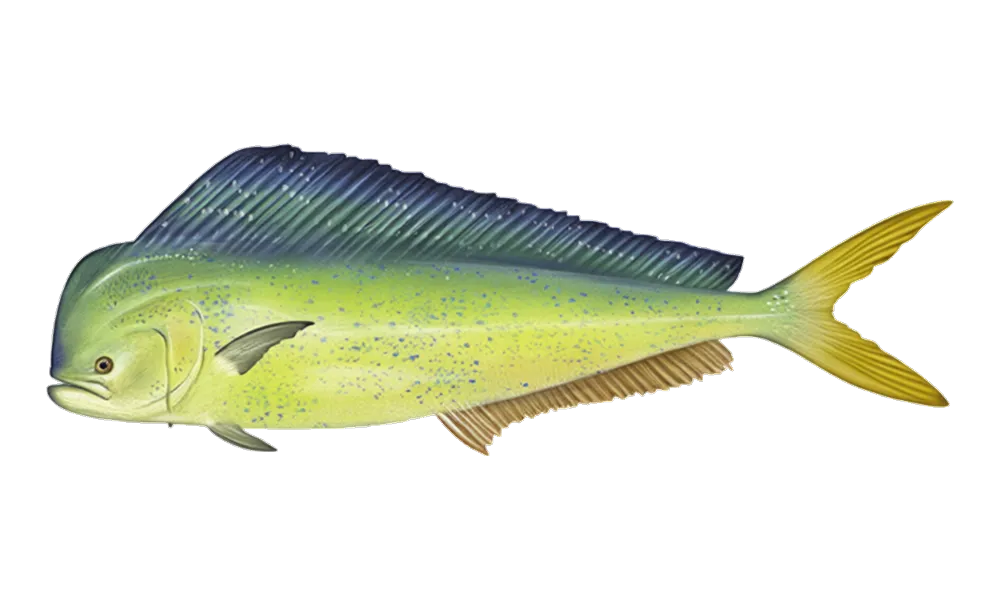
- Brilliant green-gold-blue body with iridescent flanks
- Forehead steep and near-vertical in mature bulls (males), rounded in females
- Single long dorsal fin running from just behind the head nearly to the tail
- Body laterally compressed; deeply forked yellow/gold tail
- Vivid colors fade fast to grey-yellow out of the water
Tell it apart: The single full-length dorsal fin running head to tail over a thin, deep, glowing green-gold body is unique - no other Hawaiian pelagic has that continuous dorsal.
How to Catch Mahi-Mahi
Gear links open Amazon searches. As an Amazon Associate, The Fishing Report earns from qualifying purchases — at no extra cost to you. Using these links helps keep the site ad-free.
- Best March-April; troll skirted lures and ballyhoo-style baits along weed lines and floating debris, then pitch jigs and plugs once a school is raised.GearSkirted trolling luresPitch bait jigsOffshore spinning combo
- Late spring into summer — hunt weed lines, color changes and birds 30–60 mi out, then pitch ballyhoo or jigs to the school.GearTrolling skirt lures6/0 circle hooksOffshore spinning combo
- Peaks late spring through summer; troll ballyhoo and skirted lures along weedlines and color changes, then pitch baits to the school.GearSkirted trolling luresBallyhoo rigging kitOffshore trolling combo
- Peaks late spring through summer; troll ballyhoo and skirts along weedlines and rig lines, then pitch baits to the school.GearSkirted trolling luresBallyhoo rigging kitOffshore trolling combo
- Best June-August - troll skirted ballyhoo near lobster pots and weedlines, then pitch bucktails or cut bait to the schooling fish.GearSkirted trolling luresBallyhoo rigsCasting bucktails
- Best July-August - troll skirted ballyhoo near lobster pot lines and weedlines, then pitch bucktails or cut bait to the schools.GearSkirted trolling luresBallyhoo rigsCasting bucktails
- Winter into spring is dorado season here, not summer — hunt weed lines, floating debris and working birds, then pitch ballyhoo or a bucktail and keep one hooked fish in the water to hold the school.GearTrolling skirt lures6/0 circle hooksOffshore spinning combo
- A warm-water summer visitor, June through August — pitch fly-lined baits and small swimbaits to fish holding under kelp paddies and floating debris.GearCasting swimbaitsLive-bait hooksFluorocarbon leader
When & Where Mahi-Mahi Are in Season
Peak Good Fair Slow
| Jan | Feb | Mar | Apr | May | Jun | Jul | Aug | Sep | Oct | Nov | Dec | |
|---|---|---|---|---|---|---|---|---|---|---|---|---|
| Hawaiian Islands Nearshore | ||||||||||||
| Hawaiian Islands Offshore | ||||||||||||
| Southeast Atlantic Offshore | ||||||||||||
| South Florida & the Keys Offshore | ||||||||||||
| Gulf of Mexico Offshore | ||||||||||||
| Mid-Atlantic Offshore | ||||||||||||
| Northeast Offshore | ||||||||||||
| Puerto Rico & the U.S. Virgin Islands Offshore | ||||||||||||
| Southern California Offshore |
Mahi-Mahi Regulations
HawaiiHawaii Department of Land and Natural Resources, Division of Aquatic Resources (DAR)NOAA Fisheries Pacific Islands Regional Office (in coordination with the Western Pacific Fishery Management Council)WPFMCGeorgiaGeorgia Department of Natural Resources, Coastal Resources DivisionSouth CarolinaSouth Carolina Department of Natural Resources, Marine Resources DivisionNorth CarolinaNorth Carolina Department of Environmental Quality (NC DEQ), Division of Marine FisheriesSouth Atlantic Fishery Management CouncilSAFMCAtlantic States Marine Fisheries CommissionASMFCFloridaFlorida Fish and Wildlife Conservation Commission (FWC)Gulf of Mexico Fishery Management Council (Gulf Council)GMFMCAlabamaAlabama Department of Conservation and Natural Resources, Marine Resources Division (Outdoor Alabama)MississippiMississippi Department of Marine Resources (DMR)LouisianaLouisiana Department of Wildlife and Fisheries (LDWF)TexasTexas Parks & Wildlife Department (TPWD)VirginiaVirginia Marine Resources Commission (VMRC)MarylandMaryland Department of Natural Resources, Fishing and Boating ServicesDelawareDelaware DNREC, Division of Fish & WildlifeNew JerseyNew Jersey Department of Environmental Protection, Division of Fish & Wildlife (NJDEP Fish & Wildlife)New YorkNew York State Department of Environmental Conservation (NYSDEC), Division of Marine ResourcesMid-Atlantic Fishery Management CouncilMAFMCConnecticutConnecticut Department of Energy and Environmental Protection (DEEP), Marine FisheriesRhode IslandRhode Island Department of Environmental Management (DEM), Division of Marine FisheriesMassachusettsMassachusetts Division of Marine Fisheries (MA DMF), Department of Fish and Game / Mass.govNew HampshireNew Hampshire Fish and Game Department (Marine Fisheries Division)MaineMaine Department of Marine Resources (DMR)NOAA Fisheries (Greater Atlantic Region / New England-Mid-Atlantic)NEFMCPuerto RicoPuerto Rico Department of Natural and Environmental Resources (DRNA/DNER), Office of Forestry, Wildlife and Fisheries Licences and PermitsU.S. Virgin IslandsVirgin Islands Department of Planning and Natural Resources (DPNR), Division of Fish and WildlifeCaribbean Fishery Management CouncilCFMCNOAA Fisheries Southeast Region — current U.S. Caribbean regulationsNOAA FisheriesCaliforniaCalifornia Department of Fish and Wildlife (CDFW), Marine RegionNOAA Fisheries (West Coast Region)PFMC
Always check local regulations — seasons, size, and bag limits vary by state and species, and change year to year. When in doubt, release.