 The Fishing Report
Fishing seasons & conditions by region
Chum Salmon Oncorhynchus keta
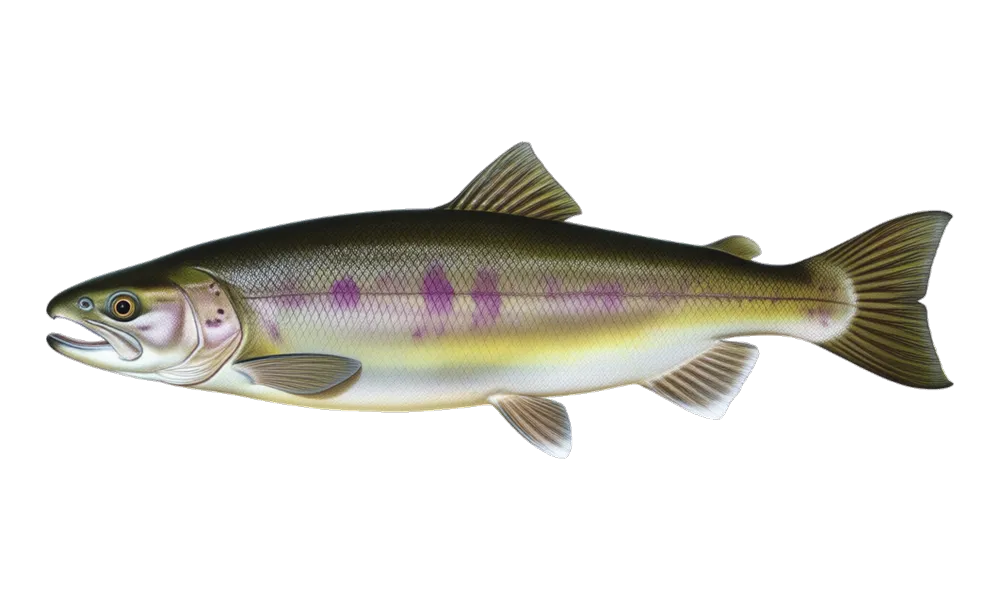
Chum Salmon Size, Range & Diet
| Typical size | 24–28 in, 8–15 lb |
|---|---|
| Maximum | up to 3.6 ft and 35 lb |
| Lifespan | 3–5 years, sometimes 6 |
| Range | Found throughout Alaska and scarce north of Kotzebue Sound, with the run continuing south along the coast through Puget Sound to about Yaquina Bay, Oregon. |
| Habitat | Salt water beaches, bays and estuaries, then the lower reaches and spring-fed side channels of coastal streams — most spawn close to tidewater. |
| Diet | Copepods, squid, mollusks and small fish at sea; near the beach they take herring and crustaceans, and fresh fish crush chartreuse and pink flies, spoons and jigs. |
Sizes are typical rod-and-reel and documented maximum figures, not size limits — see the regulations links below for the rules where you fish.
How to Identify a Chum Salmon
- No distinct spots on back or tail
- Silver at sea; spawners show purple/green vertical 'calico' bars
- Whitish tips on anal and pelvic fins
- Narrow caudal peduncle (thin tail base)
- Large, often white-rimmed pupil/eye
Tell it apart: A spotless back and tail combined with a thin caudal peduncle and white-tipped anal/pelvic fins separate chum from spotted pinks/coho and from spotless sockeye (use gill-raker count to split chum from sockeye).
Easily confused with: Sockeye Salmon, Pink Salmon, Coho / Silver Salmon
Side by side: Chum Salmon vs Coho Salmon, Chum Salmon vs Pink Salmon, Chum Salmon vs Sockeye Salmon
How to Catch Chum Salmon
Gear links open Amazon searches. As an Amazon Associate, The Fishing Report earns from qualifying purchases — at no extra cost to you. Using these links helps keep the site ad-free.
- Runs July-August; cast chartreuse and green spoons, spinners and yarn flies in tidewater and lower rivers, where hard-fighting chum take swung hardware.GearBright casting spoonsInline spinnersYarn flies
- Thick July-August in tidewater and the lower rivers; swing chartreuse and green spoons, spinners and yarn flies for fish that hit swung hardware hard.GearBright casting spoonsInline spinnersYarn flies
- Piles up at the river mouths in July; bright green and chartreuse hardware fished close to the bottom, with fresh fish fighting far above their reputation.GearBright casting spoonsInline spinnersYarn flies
When & Where Chum Salmon Are in Season
Peak Good Fair Slow
| Jan | Feb | Mar | Apr | May | Jun | Jul | Aug | Sep | Oct | Nov | Dec | |
|---|---|---|---|---|---|---|---|---|---|---|---|---|
| Alaska — Southcentral & Southeast Inshore | ||||||||||||
| Alaska — Aleutians & Alaska Peninsula Inshore | ||||||||||||
| Alaska — Bristol Bay Inshore | ||||||||||||
| Alaska — Bristol Bay Nearshore | ||||||||||||
| Alaska — Bering Strait & Kotzebue Sound Inshore | ||||||||||||
| Alaska — Bering Strait & Kotzebue Sound Nearshore | ||||||||||||
| Alaska — Bering Strait & Kotzebue Sound Offshore |
Chum Salmon Regulations
Always check local regulations — seasons, size, and bag limits vary by state and species, and change year to year. When in doubt, release.