 The Fishing Report
Fishing seasons & conditions by region
Pollock Pollachius virens
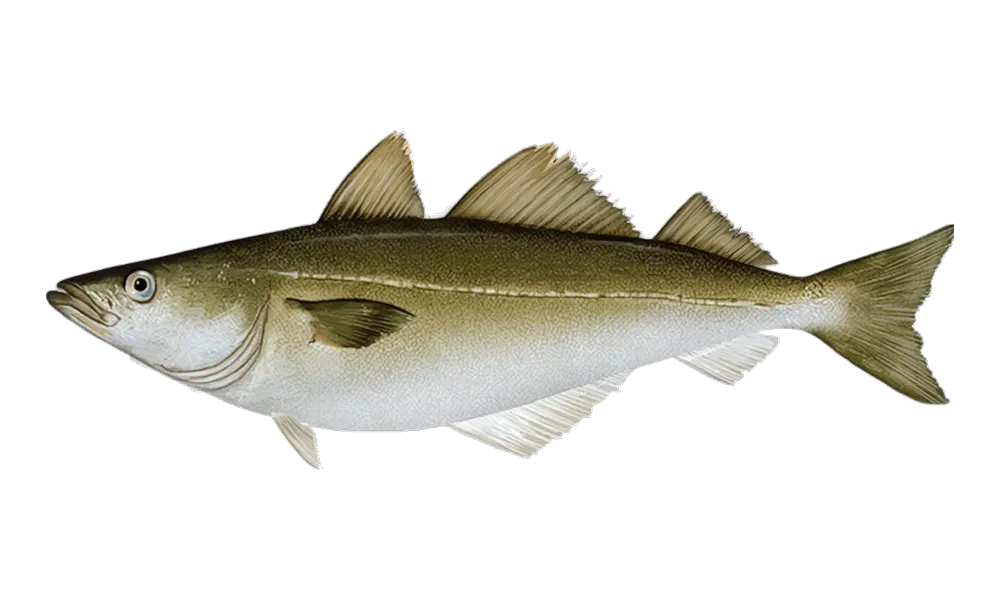
Pollock Size, Range & Diet
| Typical size | 20–32 in, 4–15 lb |
|---|---|
| Maximum | up to about 4 ft and 35 lb off New England, with North Atlantic fish recorded near 70 lb |
| Lifespan | up to 23 years |
| Range | Northwest Atlantic from Greenland and Labrador south through Nova Scotia, the Gulf of Maine and Georges Bank into the Mid-Atlantic, straggling to North Carolina. |
| Habitat | Hard rocky bottom, ledges and wrecks, with young fish in surf and harbor weed and adults near bottom in 120–1,200 ft, though big schools chase bait well up in the water column. |
| Diet | Krill, shrimp and small schooling fish — herring, sand lance and juvenile groundfish. |
Sizes are typical rod-and-reel and documented maximum figures, not size limits — see the regulations links below for the rules where you fish.
How to Identify a Pollock
- olive-green to brownish back, silvery sides
- three dorsal fins and two anal fins
- pale, only slightly curved lateral line
- projecting lower jaw with a tiny or absent chin barbel
- distinctly forked tail (unlike cod's and haddock's squared tail)
Tell it apart: A greenish back, jutting lower jaw, near-absent chin barbel, and a clearly forked tail separate pollock from the barbeled, square-tailed cod and haddock.
Easily confused with: Atlantic Cod, Haddock
Side by side: Pollock vs Atlantic Cod, Pollock vs Haddock
How to Catch Pollock
Gear links open Amazon searches. As an Amazon Associate, The Fishing Report earns from qualifying purchases — at no extra cost to you. Using these links helps keep the site ad-free.
- Best April-May in the cooler season - jig diamond jigs and rubber-tail teasers over deep wrecks and ledges, or drift clam baits.GearDiamond jigsTube teasersJigging rod
When & Where Pollock Are in Season
Peak Good Fair Slow
| Jan | Feb | Mar | Apr | May | Jun | Jul | Aug | Sep | Oct | Nov | Dec | |
|---|---|---|---|---|---|---|---|---|---|---|---|---|
| Northeast Nearshore |
Pollock Regulations
New YorkNew York State Department of Environmental Conservation (NYSDEC), Division of Marine ResourcesConnecticutConnecticut Department of Energy and Environmental Protection (DEEP), Marine FisheriesRhode IslandRhode Island Department of Environmental Management (DEM), Division of Marine FisheriesMassachusettsMassachusetts Division of Marine Fisheries (MA DMF), Department of Fish and Game / Mass.govNew HampshireNew Hampshire Fish and Game Department (Marine Fisheries Division)MaineMaine Department of Marine Resources (DMR)NOAA Fisheries (Greater Atlantic Region / New England-Mid-Atlantic)NEFMCAtlantic States Marine Fisheries CommissionASMFC
Always check local regulations — seasons, size, and bag limits vary by state and species, and change year to year. When in doubt, release.