 The Fishing Report
Fishing seasons & conditions by region
Red Snapper Lutjanus campechanus
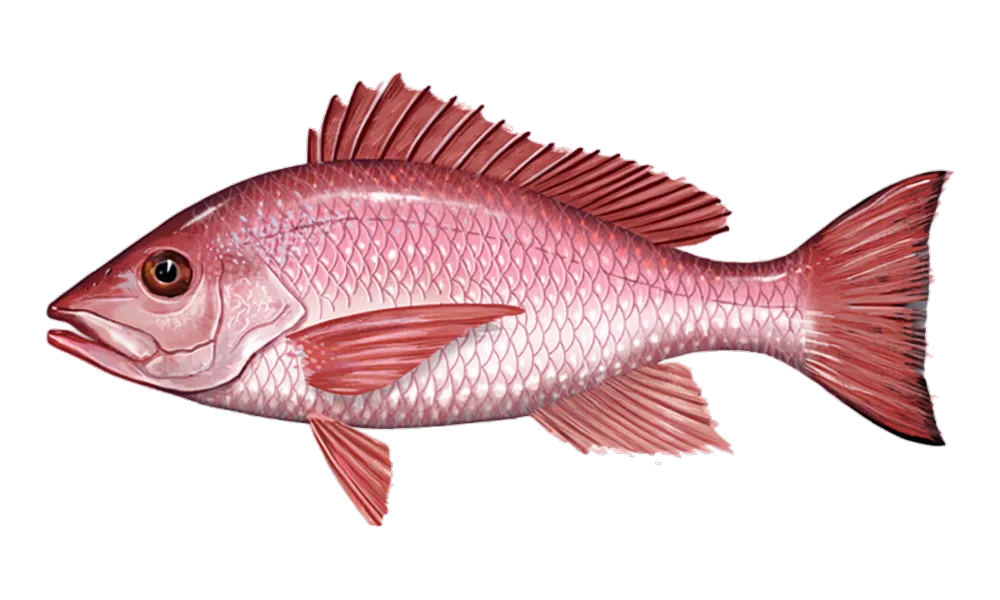
Red Snapper Size, Range & Diet
| Typical size | 16–28 in, 3–12 lb |
|---|---|
| Maximum | up to 40 in and about 50 lb |
| Lifespan | Up to 57 years |
| Range | Gulf of Mexico and the South Atlantic from Texas around Florida up the coast, seldom found north of the Carolinas. |
| Habitat | Hard structure on the continental shelf — natural ledges, rock, wrecks and artificial reefs — in roughly 30–620 ft. |
| Diet | Small fish, shrimp, crabs, squid and worms taken tight to structure. |
Sizes are typical rod-and-reel and documented maximum figures, not size limits — see the regulations links below for the rules where you fish.
How to Identify a Red Snapper
- Uniform brick-red to rosy body, red iris
- Sloping forehead and pointed snout
- Anal fin pointed/angular (not rounded)
- Enlarged canine teeth in the jaws; large mouth
- Tail only slightly forked; juveniles show a dark spot high on the side that fades with age
Tell it apart: A red eye, angular anal fin, canine teeth and a barely forked tail separate the larger red snapper from the small-mouthed, deeply-forked-tailed vermilion.
Easily confused with: Vermilion / B-sea
Side by side: Red Snapper vs Mangrove Snapper, Red Snapper vs Vermilion / B-sea
How to Catch Red Snapper
Gear links open Amazon searches. As an Amazon Associate, The Fishing Report earns from qualifying purchases — at no extra cost to you. Using these links helps keep the site ad-free.
- A very short federal season (mid-summer) — drop cut bait or pinfish on a knocker rig over live bottom and ledges.GearKnocker rigs7/0–9/0 circle hooksBottom / deep-drop combo
- Targeted during the short summer open season; drop cut bait or large jigs to reefs and rigs on a heavy knocker or Carolina rig.Gear7/0 circle hooksSnapper bottom rigsHeavy bottom-fishing combo
When & Where Red Snapper Are in Season
Peak Good Fair Slow
| Jan | Feb | Mar | Apr | May | Jun | Jul | Aug | Sep | Oct | Nov | Dec | |
|---|---|---|---|---|---|---|---|---|---|---|---|---|
| Southeast Atlantic Offshore | ||||||||||||
| Gulf of Mexico Offshore |
Red Snapper Regulations
GeorgiaGeorgia Department of Natural Resources, Coastal Resources DivisionSouth CarolinaSouth Carolina Department of Natural Resources, Marine Resources DivisionNorth CarolinaNorth Carolina Department of Environmental Quality (NC DEQ), Division of Marine FisheriesSouth Atlantic Fishery Management CouncilSAFMCAtlantic States Marine Fisheries CommissionASMFCFloridaFlorida Fish and Wildlife Conservation Commission (FWC)AlabamaAlabama Department of Conservation and Natural Resources, Marine Resources Division (Outdoor Alabama)MississippiMississippi Department of Marine Resources (DMR)LouisianaLouisiana Department of Wildlife and Fisheries (LDWF)TexasTexas Parks & Wildlife Department (TPWD)Gulf of Mexico Fishery Management Council (Gulf Council)GMFMC
Always check local regulations — seasons, size, and bag limits vary by state and species, and change year to year. When in doubt, release.