 The Fishing Report
Coho Salmon vs King Salmon
Two fish anglers routinely mix up. Here is what actually separates them — and when and where you are likely to meet each.
Side by Side
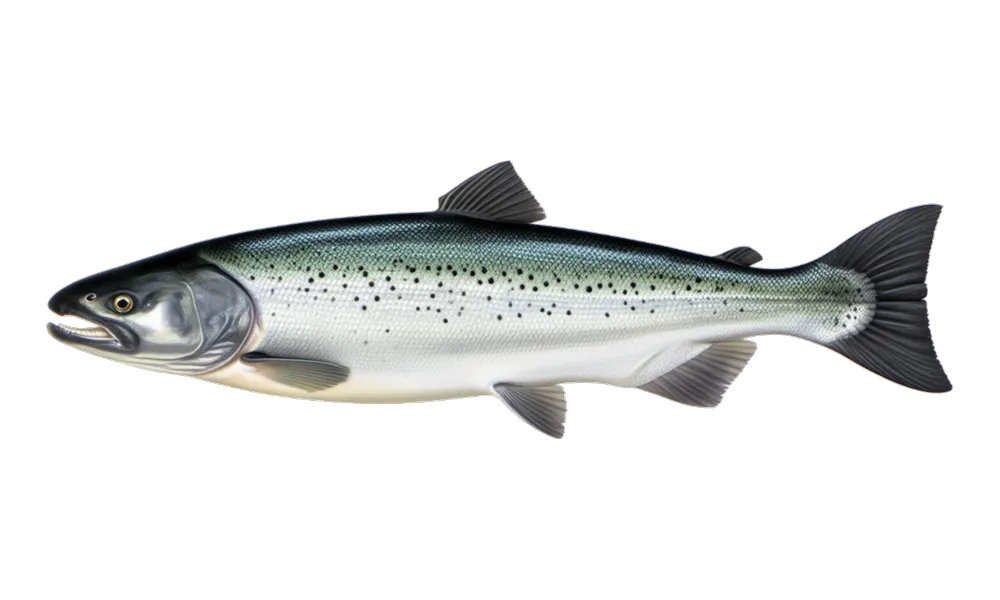
Coho Salmon Oncorhynchus kisutch
Typical: 20–26 in, 4–8 lb
Key field mark: Coho has a WHITE gum line (the reliable tell) with tail spots on the upper lobe only; Chinook has a black mouth WITH black gums and spots on both tail lobes; steelhead has a fully white mouth and gums.
- Chrome silver with a metallic blue-green back
- Black spots on the back and the UPPER lobe of the tail only
- Dark/gray mouth interior but a WHITE gum line at the tooth bases
- 12-15 anal fin rays
- Broad, only slightly forked tail
- Typically smaller and slimmer than a Chinook
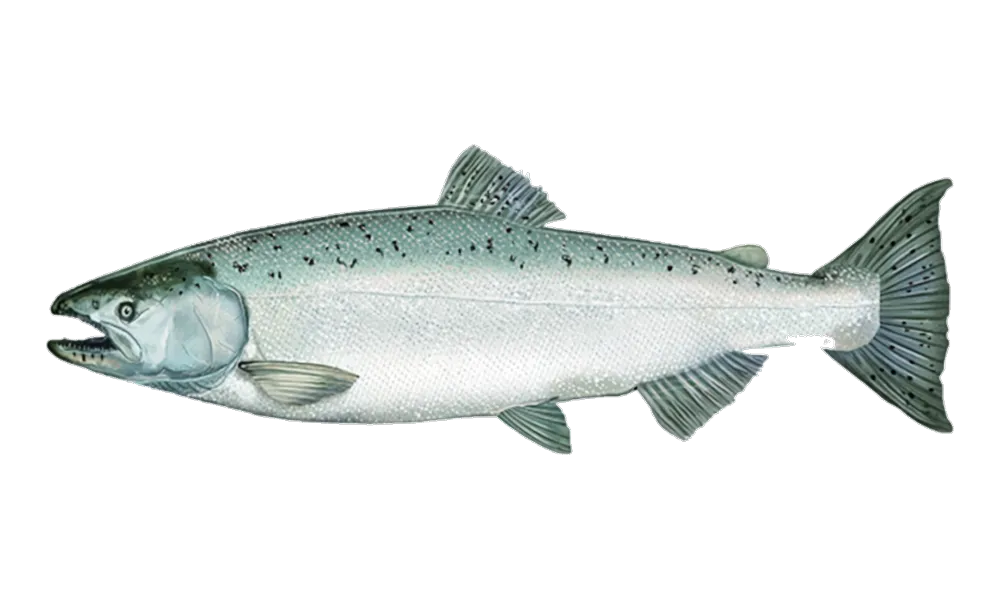
King Salmon Oncorhynchus tshawytscha
Typical: 24–36 in, 10–25 lb
Quickest tell: Spots across BOTH tail lobes plus a solid black gum line (the "blackmouth") confirm King/Chinook over Coho, which shares a dark mouth but has WHITE gums and spots only on the upper tail lobe. (An adipose fin alone proves nothing, every salmonid has one.)
- Black gum line at the base of the teeth ("blackmouth"), inside of mouth dark
- Black spots on the back AND on BOTH lobes of the tail
- Silver body with greenish-blue back, small scales, silver retained on the tail
- Robust, deep body with a broad, firm tail that holds its shape when gripped
- Anal fin shorter-based than a trout's; large sharp teeth
When Each Is Running October — current month highlighted
| Jan | Feb | Mar | Apr | May | Jun | Jul | Aug | Sep | Oct | Nov | Dec | |
|---|---|---|---|---|---|---|---|---|---|---|---|---|
| Coho Salmon | ||||||||||||
| King Salmon |
Where Coho Salmon and King Salmon Overlap
Both run in Alaska — Southcentral & Southeast, Alaska — Bristol Bay, Alaska — Aleutians & Alaska Peninsula, Great Lakes, Pacific Northwest — that is where telling them apart actually matters.