 The Fishing Report
Nome, AK Fishing — Seasons & Conditions
Norton Sound road-system fishing out of the Snake River — sea-run Dolly Varden and Arctic char along the beaches, chums and pinks through midsummer, silvers in September, and grayling and pike on the tundra roads.
Part of the Alaska — Bering Strait & Kotzebue Sound region.
What’s Biting at Nome, AK in October 2026
Biting right now — 5 species are worth targeting in October here.
Tap any species for how to identify it, when it runs and what to throw. This is when the fish are active here — check the regulations below before you keep anything.
Fishing Nome, AK: The Local Water
The Inlet & Bar
The entrance channel to Nome Harbor runs northeast between a causeway on the west and a breakwater on the east, both marked at their outer ends by seasonal lights, then continues northeast through the mouth of the Snake River and turns southeast into an inner harbor. The inner-harbor entrance carries a 29.9-degree lighted range and private seasonal buoys; that inner range does not mark a safe passage to the outer harbor.
Local Waters
Water levels here are governed more by wind than by tide — an offshore wind can hold the level 2 to 3 feet below mean lower low water for days at a time, and a storm has raised it 14 feet above. About 2 miles offshore in the Nome roadstead the tidal current averages about 1 knot at strength and is chiefly diurnal, flooding east and ebbing northwest. Deep-draft vessels anchor in 7 to 8 fathoms about a mile off the beach.
Reefs, Structure & Marks
Cape Nome, 11 miles east of town, is a bluff about 650 feet high and a mile broad, rounding down to low land on either side, with an active rock quarry and pier at its base. Topkok Head, the first highland close to the coast east of Cape Nome, rises abruptly 586 feet from the water and is a well-known landmark. West of Cape Nome the coast is a straight low sand beach broken by small rivers, with the bottom irregular inside the 3-fathom line.
Harbors, Launches & Access
The entrances to the Nome, Penny and Sinuk Rivers have shifting bars, but there is generally enough water over them for boats of 3-foot draft. Port Safety, about 8 miles east of Cape Nome, is a small anchorage for vessels under 7-foot draft with a narrow channel reported at 7 feet and a bridge across the entrance; sheltered anchorage for several small vessels can be had in the narrow sloughs between the flats inside.
Nome, AK Season Calendar October — current month highlighted
Rivers, Sloughs & Lagoons
| Jan | Feb | Mar | Apr | May | Jun | Jul | Aug | Sep | Oct | Nov | Dec | |
|---|---|---|---|---|---|---|---|---|---|---|---|---|
| Sheefish | ||||||||||||
| Arctic Char | ||||||||||||
| Dolly Varden | ||||||||||||
| Arctic Grayling | ||||||||||||
| Northern Pike | ||||||||||||
| Broad Whitefish | ||||||||||||
| Chum Salmon | ||||||||||||
| Pink Salmon | ||||||||||||
| Coho / Silver Salmon |
Coastal Lagoons & Sounds
| Jan | Feb | Mar | Apr | May | Jun | Jul | Aug | Sep | Oct | Nov | Dec | |
|---|---|---|---|---|---|---|---|---|---|---|---|---|
| Dolly Varden | ||||||||||||
| Chum Salmon | ||||||||||||
| Pink Salmon | ||||||||||||
| Coho / Silver Salmon | ||||||||||||
| Sheefish |
The Open Coast
| Jan | Feb | Mar | Apr | May | Jun | Jul | Aug | Sep | Oct | Nov | Dec | |
|---|---|---|---|---|---|---|---|---|---|---|---|---|
| Chum Salmon | ||||||||||||
| Coho / Silver Salmon | ||||||||||||
| Dolly Varden |
What to Target & How
Gear links open Amazon searches. As an Amazon Associate, The Fishing Report earns from qualifying purchases — at no extra cost to you. Using these links helps keep the site ad-free.
Inshore
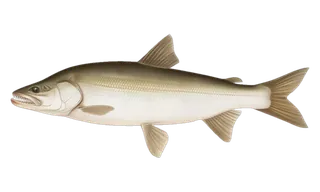 Sheefish — Hunts smelt and whitefish in the silty main channels; troll or cast big flashy spoons and large streamers deep along the seam between current and slack water.GearLarge flashy spoonsBig streamersMedium-heavy combo
How to ID
- White to silvery body with no spots or other markings at all
- Very large scales
- Lower jaw projecting beyond the upper jaw
- Mouth full of small, densely packed teeth
Tell it apart: A big unspotted silver fish with very large scales and a lower jaw that juts past the upper — a broad whitefish has the opposite, a small down-turned mouth under a blunt head.
Easily confused with: Broad Whitefish
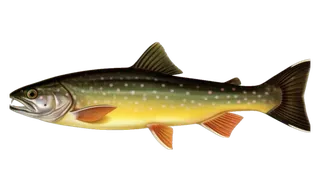 Arctic Char — Stages in brackish lagoons behind the barrier beaches before running up; small bright spoons and shrimp-colored streamers worked along the channel edge on moving water.GearSmall casting spoonsShrimp-pattern streamersLight spinning combo
How to ID
- Light spots on a dark background
- Sparse pink to red spots on the back and sides, 15–20 below the lateral line, each LARGER than the pupil
- Slim caudal peduncle and a noticeably forked tail
- Leading edge of the lower fins is typically white
- Spawning fish are usually gold, orange, yellow or rose, and only rarely red
Tell it apart: Fewer and larger spots, a narrow caudal peduncle and a deeply forked tail mark an Arctic char; a spawning male also carries a much smaller kype than a Dolly Varden's.
Easily confused with: Dolly Varden
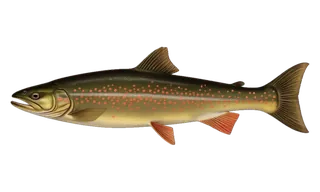 Dolly Varden — Shares the lagoons and lower rivers with the char through the short open-water season; beads, egg patterns and small spoons on the current seams.GearSmall casting spoonsBead rigsLight spinning combo
How to ID
- Light-colored spots on a darker greenish body — the inverse of a trout
- Many small spots, each SMALLER than the pupil of the eye
- Relatively thick caudal peduncle and only a slightly forked tail
- Spawning males develop a distinct kype, red-black-and-white bellies, black gill covers and bright orange to red spots
Typical: 12–24 in
Tell it apart: Spots smaller than the eye's pupil, a thick caudal peduncle and a barely forked tail separate a Dolly Varden from an Arctic char, which has fewer and larger spots on a slimmer peduncle behind a deeply forked tail.
Easily confused with: Arctic Char
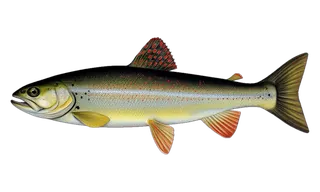 Arctic Grayling — The most dependable fish up here; sits in clear tributaries above the silt line and rises to a dry fly or a small spinner drifted through the head of a run.GearDry fliesSmall inline spinnersLight fly rod
How to ID
- Large sail-like dorsal fin with a scalloped edge — unmistakable
- Dorsal fringed in red and dotted with large iridescent red, aqua or purple spots
- Dark back; sides can be black, silver, gold or blue depending on the stream
- Sides of the body and head freckled with black spots
- A black slash on each side of the lower jaw
Typical: 10–12 in at maturity
Tell it apart: Nothing else in Alaskan fresh water carries that huge sail-like dorsal fin, fringed in red and spotted with iridescent color.
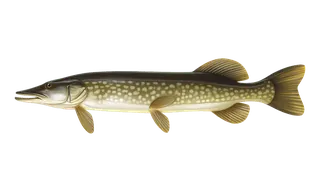 Northern Pike — Lies in the warm shallow margins of tundra sloughs and lake outlets all summer; big spoons and wire-leadered streamers along the weed edge.GearLarge spoonsWire leadersHeavy spinning combo
How to ID
- Elongated body and head with a broad, flat, duck-bill snout
- Light bean-shaped spots on a darker green-to-olive background
- A single soft-rayed dorsal fin set far back on the body
- A mouth full of sharp teeth that are constantly replaced
- Color tracks the water — light green from clear lakes, much darker from a stained slough
Typical: Fish up to about 20 lb are common in some Alaskan rivers and lakes
Tell it apart: The duck-bill snout and a single soft dorsal set far back, over LIGHT bean-shaped spots on a dark body — there is no similar fish in Alaskan fresh water.
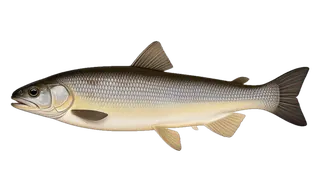 Broad Whitefish — Feeds head-down on snails and insect larvae over soft bottom; tiny baited hooks fished right on the deck, with a very light touch on the take.GearSmall bait hooksSplit shot and floatsUltralight combo
How to ID
- Body very broad from back to belly compared with other whitefish — the source of the name
- Blunt head with a very small, slightly down-turned mouth adapted to feeding off the bottom
- Elongated body covered in silvery scales
- Deeply forked tail and an adipose fin
- Belly white to faded yellow; cheeks may carry brownish spots, and the fins are dark
Typical: about 500–600 mm (20–24 in), 4.5–11 lb at maturity
Tell it apart: The small, distinctly down-turned bottom-feeder's mouth under a blunt head is the tell — a sheefish has a large mouth with the lower jaw thrust forward.
Easily confused with: Sheefish
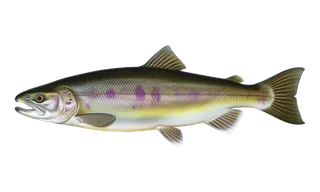 Chum Salmon — Piles up at the river mouths in July; bright green and chartreuse hardware fished close to the bottom, with fresh fish fighting far above their reputation.GearBright casting spoonsInline spinnersYarn flies
How to ID
- No distinct spots on back or tail
- Silver at sea; spawners show purple/green vertical 'calico' bars
- Whitish tips on anal and pelvic fins
- Narrow caudal peduncle (thin tail base)
- Large, often white-rimmed pupil/eye
Typical: 24–28 in, 8–15 lb
Tell it apart: A spotless back and tail combined with a thin caudal peduncle and white-tipped anal/pelvic fins separate chum from spotted pinks/coho and from spotless sockeye (use gill-raker count to split chum from sockeye).
Easily confused with: Pink Salmon, Coho / Silver Salmon
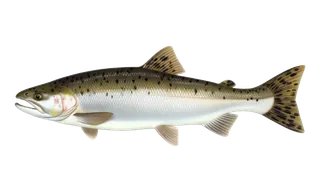 Pink Salmon — Short even-year run through August; small pink spoons and jigs cast into the schools holding off the river mouths.GearPink casting spoonsSmall pink jigsLight salmon combo
How to ID
- Large oval/oblong black blotches over the entire tail AND on the back
- Very small scales (smallest of any Pacific salmon)
- Bright silver at sea; smallest, most slender Pacific salmon
- Spawning males develop a pronounced humped back
Typical: 18–25 in, 3–5 lb
Tell it apart: Big oval spots covering the WHOLE tail plus the tiniest scales of any salmon clinch a pink; coho spot only the upper lobe and chum has no real spots.
Easily confused with: Coho / Silver Salmon, Chum Salmon
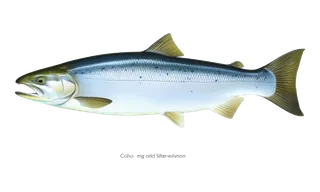 Coho / Silver Salmon — The last run of the year, along the surf line and lagoon entrances in September; cast spoons from the beach or work a skiff just outside the breakers.GearCasting spoonsInline spinnersSalmon spinning combo
How to ID
- Black mouth interior but WHITE/gray gums at base of teeth on lower jaw
- Spots on back and on the UPPER tail lobe only (lower lobe usually clean)
- Bright silver sides, blue back; broad caudal peduncle
- Moderately forked tail
Typical: 24–30 in, 8–12 lb
Tell it apart: White/gray gums (against the black mouth) with spots confined to the upper tail lobe mark a coho versus the king's black gumline and fully spotted tail.
Fishing Regulations
Tides & Timing
Read the Tide
Tides are small along most of this coast — a foot or two at Nome and Kotzebue — so wind, not tide, sets the water level: a hard onshore blow can raise it several feet and an offshore wind can drop it below chart datum for days. Ice governs the calendar far more than either, with open water running roughly from breakup in June to freeze-up in October.
Other towns in the Alaska — Bering Strait & Kotzebue Sound
Back to the Alaska — Bering Strait & Kotzebue Sound overview →