 The Fishing Report
Naknek, AK Fishing — Seasons & Conditions
Mouth of the Naknek River on Kvichak Bay — the heart of the Bristol Bay sockeye fishery, with kings and silvers in the river and trophy rainbows and char up toward Naknek Lake.
Part of the Alaska — Bristol Bay region.
What’s Biting at Naknek, AK in October 2026
Biting right now — 5 species are worth targeting in October here, and the one marked Peak is at its best right now.
Tap any species for how to identify it, when it runs and what to throw. This is when the fish are active here — check the regulations below before you keep anything.
Fishing Naknek, AK: The Local Water
The Inlet & Bar
Naknek River enters Kvichak Bay on the east side about 10 miles south of Koggiung, with Cape Suworof the point on the north side of the entrance. Shoals and banks, many of which uncover, fill the lower course of the river and reach 3 or 4 miles out before trending north to join the banks filling the upper end of Kvichak Bay.
Local Waters
Anchorage off the entrance to the Naknek River is in 35 to 40 feet, the head of navigation for deep-draft vessels, and the approach channel carries 33 to 60 feet. Deep-draft vessels anchor about 6 miles off the river entrance and lighter freight ashore by barge; the approaches to the anchorages vary little from year to year.
Reefs, Structure & Marks
The hole, just east of Morakas Point 4 miles above the river mouth, holds 9 to 14 feet at low water over a narrow crooked area 200 to 300 feet wide and about 0.5 mile long — the one spot where vessels drawing up to 10 feet stay afloat at low water. An overhead power cable with a clearance of 48 feet crosses the Naknek River about 1.3 miles above Morakas Point.
Harbors, Launches & Access
The town is on the north side of the Naknek River about 1.5 miles from the mouth, with South Naknek directly across the river. The salmon canneries along the river all have wharves that bare alongside at low water; vessels drawing up to 10 feet can come alongside at half tide. Craft drawing up to about 12 feet can work some 12 miles up the river with local knowledge, leaving the village an hour before high water, and 3-foot boats can reach the rapids about 7.5 miles beyond.
Naknek, AK Season Calendar October — current month highlighted
Rivers, Lakes & Tidewater
| Jan | Feb | Mar | Apr | May | Jun | Jul | Aug | Sep | Oct | Nov | Dec | |
|---|---|---|---|---|---|---|---|---|---|---|---|---|
| Sockeye Salmon | ||||||||||||
| Chinook / King Salmon | ||||||||||||
| Chum Salmon | ||||||||||||
| Pink Salmon | ||||||||||||
| Coho / Silver Salmon | ||||||||||||
| Rainbow Trout | ||||||||||||
| Dolly Varden | ||||||||||||
| Arctic Grayling | ||||||||||||
| Northern Pike |
Nushagak & Kvichak Bays
| Jan | Feb | Mar | Apr | May | Jun | Jul | Aug | Sep | Oct | Nov | Dec | |
|---|---|---|---|---|---|---|---|---|---|---|---|---|
| Sockeye Salmon | ||||||||||||
| Chinook / King Salmon | ||||||||||||
| Chum Salmon | ||||||||||||
| Coho / Silver Salmon | ||||||||||||
| Dolly Varden |
Outer Bristol Bay
| Jan | Feb | Mar | Apr | May | Jun | Jul | Aug | Sep | Oct | Nov | Dec | |
|---|---|---|---|---|---|---|---|---|---|---|---|---|
| Pacific Halibut | ||||||||||||
| Pacific Cod | ||||||||||||
| Coho / Silver Salmon |
What to Target & How
Gear links open Amazon searches. As an Amazon Associate, The Fishing Report earns from qualifying purchases — at no extra cost to you. Using these links helps keep the site ad-free.
Inshore
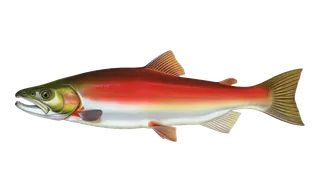 Sockeye Salmon — Bristol Bay's run peaks late June into July; short-line a weighted sparse fly or bare hook through the travel lane along the bank, where reds move in dense pulses.GearSockeye fliesBead and yarn rigsDrift fishing rod
How to ID
- No spots on back or tail
- Bright silver body at sea, greenish-blue back; prominent glassy eye
- Many long, fine, serrated and closely spaced gill rakers on the first arch (over 30–40)
- Spawners turn bright red with a green head
Typical: 22–28 in, 4–8 lb
Tell it apart: Spotless body plus numerous long, fine, closely set gill rakers (count them on the first arch — far more than chum's short, sparse rakers) confirm a sockeye.
Easily confused with: Chum Salmon, Pink Salmon, Coho / Silver Salmon
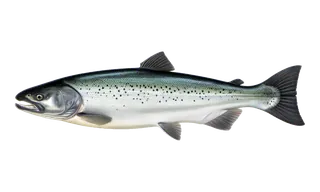
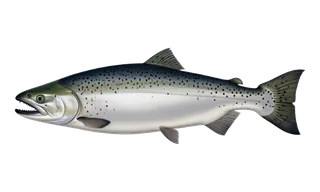 Chinook / King Salmon — Runs June-July on the Nushagak and the Peninsula rivers; back-troll plugs and drift bobber-and-yarn through holding water, or troll cut-plug herring in the salt.GearCut-plug herring rigSalmon plugsSalmon mooching rod
How to ID
- Black gums/gumline at base of teeth on lower jaw (mouth interior also dark)
- Irregular black spots on the back AND on BOTH lobes of the tail
- Silver body, blue-green back; large, robust, deep-bodied
- Spots present on entire caudal fin, not just the upper lobe
Typical: 24–36 in, 15–30 lb
Tell it apart: Black gumline along the lower jaw PLUS spots covering both tail lobes separate a king from a coho's pale/white gums and upper-lobe-only tail spotting. Don't rely on size or fin-ray counts alone.
Easily confused with: Coho / Silver Salmon
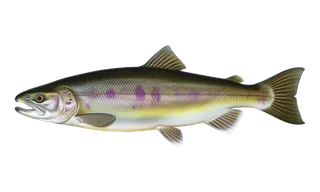 Chum Salmon — Thick July-August in tidewater and the lower rivers; swing chartreuse and green spoons, spinners and yarn flies for fish that hit swung hardware hard.GearBright casting spoonsInline spinnersYarn flies
How to ID
- No distinct spots on back or tail
- Silver at sea; spawners show purple/green vertical 'calico' bars
- Whitish tips on anal and pelvic fins
- Narrow caudal peduncle (thin tail base)
- Large, often white-rimmed pupil/eye
Typical: 24–28 in, 8–15 lb
Tell it apart: A spotless back and tail combined with a thin caudal peduncle and white-tipped anal/pelvic fins separate chum from spotted pinks/coho and from spotless sockeye (use gill-raker count to split chum from sockeye).
Easily confused with: Sockeye Salmon, Pink Salmon, Coho / Silver Salmon
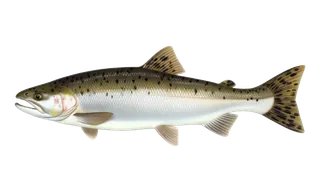 Pink Salmon — Heavy on even years July-August; cast small pink spoons and jigs into the schools stacked at river mouths and along tide rips.GearPink casting spoonsSmall pink jigsLight salmon combo
How to ID
- Large oval/oblong black blotches over the entire tail AND on the back
- Very small scales (smallest of any Pacific salmon)
- Bright silver at sea; smallest, most slender Pacific salmon
- Spawning males develop a pronounced humped back
Typical: 18–25 in, 3–5 lb
Tell it apart: Big oval spots covering the WHOLE tail plus the tiniest scales of any salmon clinch a pink; coho spot only the upper lobe and chum has no real spots.
Easily confused with: Coho / Silver Salmon, Chum Salmon
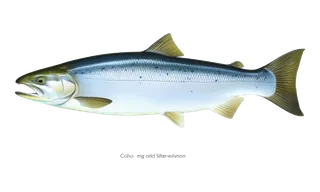 Coho / Silver Salmon — Best August into October, later than Southeast; cast bright spoons and spinners across tidewater current and swing them, or troll herring outside the lagoons.GearCasting spoonsInline spinnersSalmon spinning combo
How to ID
- Black mouth interior but WHITE/gray gums at base of teeth on lower jaw
- Spots on back and on the UPPER tail lobe only (lower lobe usually clean)
- Bright silver sides, blue back; broad caudal peduncle
- Moderately forked tail
Typical: 24–30 in, 8–12 lb
Tell it apart: White/gray gums (against the black mouth) with spots confined to the upper tail lobe mark a coho versus the king's black gumline and fully spotted tail.
Easily confused with: Chinook / King Salmon
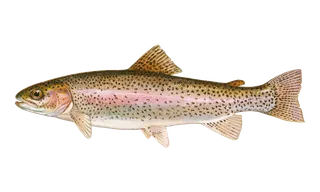
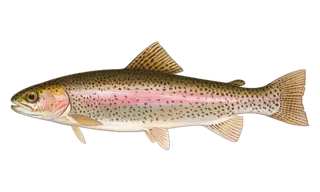 Rainbow Trout — Bristol Bay's big resident rainbows key on the sockeye spawn; fish beads and egg patterns through the gravel August-September, then swing flesh and streamers into October.GearTrout beadsFlesh and egg fliesSingle-hand trout rod
How to ID
- Reddish-pink band along each side about the midline, from faint to radiant
- Small black spots over the back above the lateral line, and on the upper fins and tail
- 8 to 12 rays in the anal fin
- No teeth at the base of the tongue
- Sea-run steelhead are silvery or brassy, more slender, and heavily spotted both above AND below the lateral line
Tell it apart: The pink midline band with black spotting confined above the lateral line, 8–12 anal-fin rays and no teeth at the tongue base positively identify a rainbow.
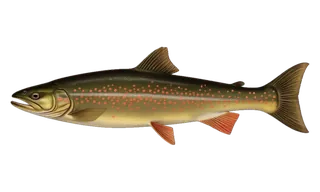 Dolly Varden — Sea-run dollies follow the salmon in from June; small bright spoons, beads and egg patterns along current seams and behind spawning fish.GearSmall casting spoonsBead rigsLight spinning combo
How to ID
- Light-colored spots on a darker greenish body — the inverse of a trout
- Many small spots, each SMALLER than the pupil of the eye
- Relatively thick caudal peduncle and only a slightly forked tail
- Spawning males develop a distinct kype, red-black-and-white bellies, black gill covers and bright orange to red spots
Typical: 12–24 in
Tell it apart: Spots smaller than the eye's pupil, a thick caudal peduncle and a barely forked tail separate a Dolly Varden from an Arctic char, which has fewer and larger spots on a slimmer peduncle behind a deeply forked tail.
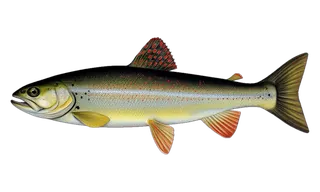 Arctic Grayling — A Peninsula and Bristol Bay fish — there are no grayling in the Aleutians. Rises freely in the clear tributaries above the silt line all summer; a dry fly or a small spinner drifted through the head of a run is usually enough.GearDry fliesSmall inline spinnersLight fly rod
How to ID
- Large sail-like dorsal fin with a scalloped edge — unmistakable
- Dorsal fringed in red and dotted with large iridescent red, aqua or purple spots
- Dark back; sides can be black, silver, gold or blue depending on the stream
- Sides of the body and head freckled with black spots
- A black slash on each side of the lower jaw
Typical: 10–12 in at maturity
Tell it apart: Nothing else in Alaskan fresh water carries that huge sail-like dorsal fin, fringed in red and spotted with iridescent color.
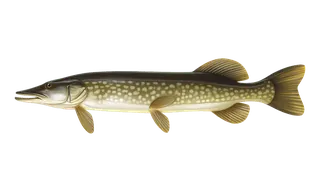 Northern Pike — Holds in warm weedy slough margins and lake outlets; work big spoons and wire-leadered streamers along the weed edge, where pike hit in weather nothing else will.GearLarge spoonsWire leadersHeavy spinning combo
How to ID
- Elongated body and head with a broad, flat, duck-bill snout
- Light bean-shaped spots on a darker green-to-olive background
- A single soft-rayed dorsal fin set far back on the body
- A mouth full of sharp teeth that are constantly replaced
- Color tracks the water — light green from clear lakes, much darker from a stained slough
Typical: Fish up to about 20 lb are common in some Alaskan rivers and lakes
Tell it apart: The duck-bill snout and a single soft dorsal set far back, over LIGHT bean-shaped spots on a dark body — there is no similar fish in Alaskan fresh water.
Offshore
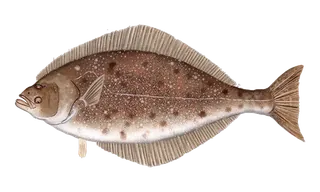 Pacific Halibut — Not a fishery at the head of the bay — the flats run for miles and the water only gets deep enough well down the Peninsula side, a long committing run in the open bay.GearHeavy circle hooksLarge leadhead jigsHalibut rod combo
How to ID
- Both eyes on the right (dark, upper) side; right-eyed flatfish
- Large diamond/oval flat body, lies on its side
- Dark brown/mottled top side, white underside
- Large mouth reaching to the eye; strongly forked (lunate) tail
- Lateral line arches high over the pectoral fin
Typical: 30–45 in, 12–40 lb
Tell it apart: A large right-eyed flatfish with a strongly forked tail and white underside is a halibut, not an arrowtooth flounder (slimmer, large-mouthed, nearly straight tail) — confirm the forked tail and arched lateral line.
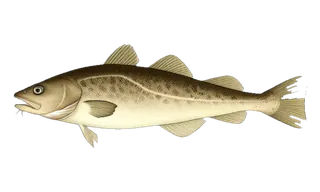 Pacific Cod — Same water as the halibut, well out toward the Peninsula — over hard bottom with a plain leadhead and a big soft tail worked slowly.GearHeavy bottom jigsShrimp fly bait rigsBottomfish rod combo
How to ID
- Single long chin barbel (whisker) at least as long as eye diameter
- Three separate dorsal fins and two anal fins
- Brown/gray mottled body, pale belly
- Pale, curved lateral line
- Rounded/square tail, blunt snout
Typical: 20–32 in, 5–15 lb
Tell it apart: The single fleshy chin barbel and three separate dorsal fins are unique among Alaska bottomfish and immediately separate cod from the barbel-less, single-dorsal lingcod.
Fishing Regulations
Tides & Timing
Read the Tide
Bristol Bay has some of the largest tidal ranges in North America — over 20 feet at the head of Nushagak Bay, with flats that dry for miles and a controlling depth of only about 10 feet up to Dillingham. Tide governs everything here: when you can get off the mud, when the fish push into the rivers, and how hard the bay chops when a strong current meets the wind.