 The Fishing Report
Hilton Head Island, SC Fishing — Seasons & Conditions
South Carolina barrier island with Calibogue and Port Royal Sounds flanking it — flats and creeks for reds, trout and flounder, plus a short run to nearshore reefs and the Gulf Stream in summer.
Part of the Southeast Atlantic region.
What’s Biting at Hilton Head Island, SC in October 2026
Biting right now — 11 species are worth targeting in October here, and the 6 marked Peak are at their best right now.
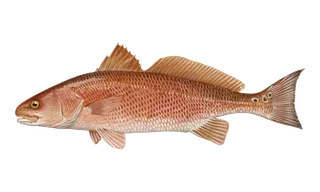 RedfishPeak
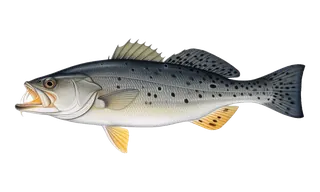 Spotted SeatroutPeak
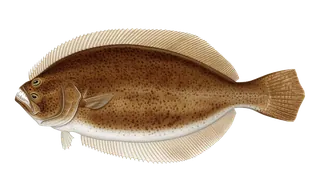 FlounderPeak
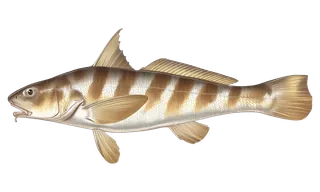 Whiting (Kingfish)Peak
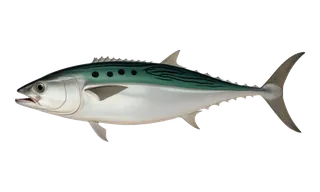 Bonito / FAPeak
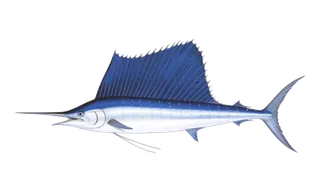 SailfishPeak
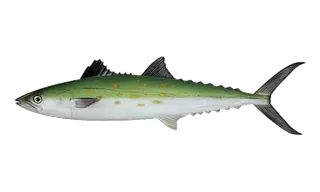 Spanish Mackerel
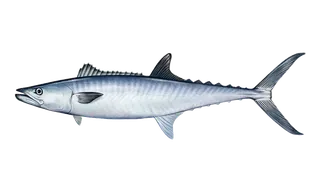 King Mackerel
 Sharks
 Blackfin Tuna
 Vermilion / B-sea
Tap any species for how to identify it, when it runs and what to throw. This is when the fish are active here — check the regulations below before you keep anything.
Fishing Hilton Head Island, SC: The Local Water
The Inlet & Bar
Two doors to the ocean, neither jettied: deep Port Royal Sound to the north, and Calibogue Sound to the south, where the bar is a maze of shifting shoals and crooked channels — mind the submerged breakwater northeast of Tybee Light on the southern route.
Local Waters
Broad Creek nearly splits the island, Skull and Mackay creeks carry the ICW behind it, and the May, Chechessee and Colleton rivers are in easy reach — all big-tide spartina marsh, with Port Royal Sound running a genuinely deep 26-50 ft.
Reefs, Structure & Marks
Off the Port Royal sea buoy: the Hilton Head Reef (PA-49) 5 nm out in 50 ft with barges and Army tanks, Eagle's Nest Reef (PA-48) at 5.5 nm in 70 ft, and the Betsy Ross Reef (PA-44) at 8.4 nm — a 430-ft Liberty ship with New York subway cars for company.
Harbors, Launches & Access
Cross Island and Marshland landings on Broad Creek serve the island itself; C.C. Haigh Jr. (with a fishing pier) and Buckingham landings sit on Mackay Creek just over the bridge. The public piers here fish the creeks and sounds — Jenkins Island on Skull Creek, Old House Creek — not the ocean beach.
Hilton Head Island, SC Season Calendar October — current month highlighted
Inshore — Sounds, Creeks, Jetties
| Jan | Feb | Mar | Apr | May | Jun | Jul | Aug | Sep | Oct | Nov | Dec | |
|---|---|---|---|---|---|---|---|---|---|---|---|---|
| Redfish | ||||||||||||
| Spotted Seatrout | ||||||||||||
| Flounder | ||||||||||||
| Sheepshead | ||||||||||||
| Black Drum | ||||||||||||
| Whiting (Kingfish) | ||||||||||||
| Tarpon | ||||||||||||
| Tripletail |
Nearshore — Beach to ~20 mi
| Jan | Feb | Mar | Apr | May | Jun | Jul | Aug | Sep | Oct | Nov | Dec | |
|---|---|---|---|---|---|---|---|---|---|---|---|---|
| Spanish Mackerel | ||||||||||||
| King Mackerel | ||||||||||||
| Cobia | ||||||||||||
| Bonito / FA | ||||||||||||
| Sharks |
Offshore — Ledges, Snapper Banks, Gulf Stream
| Jan | Feb | Mar | Apr | May | Jun | Jul | Aug | Sep | Oct | Nov | Dec | |
|---|---|---|---|---|---|---|---|---|---|---|---|---|
| Wahoo | ||||||||||||
| Blackfin Tuna | ||||||||||||
| Mahi (Dolphin) | ||||||||||||
| Sailfish | ||||||||||||
| Marlin | ||||||||||||
| Red Snapper* | ||||||||||||
| Vermilion / B-sea |
What to Target & How
Gear links open Amazon searches. As an Amazon Associate, The Fishing Report earns from qualifying purchases — at no extra cost to you. Using these links helps keep the site ad-free.
Inshore
- Redfish — Year-round — sight-cast gold spoons and topwater to tailing fish on summer flood tides; in winter slow a soft-plastic for schooled fish in clear creeks.GearGold weedless spoonsFish-finder bottom rigs7/0–8/0 circle hooks
How to ID
- Coppery-bronze to reddish back, white belly
- One or more black ocellated (eyespot) spots at base of tail
- No barbels under chin
- Square-ish, slightly notched tail
- Subterminal (underslung) mouth, no large canines
Typical: 18–30 in, 3–10 lb; bulls run well over 40 in
Tell it apart: The black spot(s) on the tail base plus the absence of chin barbels separate redfish from the barbeled, bar-sided black drum.
Easily confused with: Black Drum
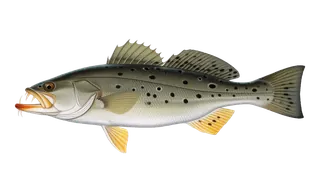 Spotted Seatrout — Warm months — work topwater and paddletails fast over grass flats; cold months — crawl a slow-sinking twitchbait through deeper mud holes.GearMirrOlure twitchbaitsPaddletails + jigheadsPopping corks
How to ID
- Silvery body, dark gray/green back
- Distinct round black spots scattered over back AND running onto the dorsal fin and tail
- Two prominent canine fangs at tip of upper jaw
- Soft, elongate body; no barbels
- Yellow-orange mouth lining
- No black spot at the base of the tail
Typical: 14–20 in, 1–3 lb
Tell it apart: Loose black spots that extend onto the fins and tail, plus two large canine teeth, confirm a seatrout; redfish instead has no canines and one or more spots only at the tail base.
Easily confused with: Redfish
- Flounder — Drag a jighead with a mud minnow or Gulp! along sandy edges and inlets — the fall run (Oct–Nov) as they stage to leave is the window.GearSoft-plastic jigheadsGulp! soft baitsFlounder rigs
How to ID
- Flat, oval body lying on one side
- Both eyes on the same (upper) side of the head
- Brown mottled upper side with scattered ocellated spots, white blind underside
- Large mouth with sharp teeth
- Continuous dorsal and anal fins fringing the body margin
Typical: 12–20 in, 1–3 lb
Tell it apart: A flat fish with both eyes on the same side, lying on its blind white underside, is unmistakably a flounder; no other regional gamefish is laterally compressed onto one side.
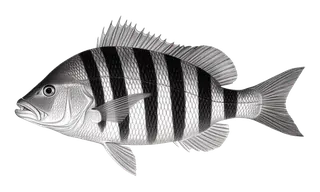 Sheepshead — Winter into early spring — fish fiddler crabs or shrimp tight to jetty rock and pilings; set on the lightest tick.GearSheepshead hooksKnocker rigs20 lb fluorocarbon leader
How to ID
- Silvery body with 5-6 bold black vertical bars
- Prominent human-like incisor teeth at front of mouth
- Strong, sharp dorsal and anal fin spines
- Steep, blunt forehead profile
- Small terminal mouth, no chin barbels
Typical: 14–18 in, 2–5 lb
Tell it apart: Forward-set human-like incisor teeth and the absence of chin barbels distinguish sheepshead from the similarly barred but barbeled, blunt-toothed black drum.
Easily confused with: Black Drum
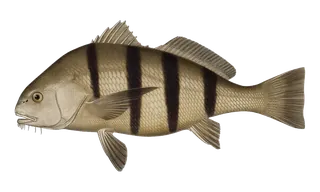 Black Drum — Late winter into spring — half a blue crab on a bottom rig over hard bottom and around bridges in 8–15 ft.GearFish-finder rigs6/0 circle hooksBank sinkers
How to ID
- High-backed gray to silvery body, brassy sheen
- Several chin barbels under the lower jaw
- Young show 4-5 dark vertical bars (fade with age)
- Cobblestone-like crushing pharyngeal teeth, no canines
- Subterminal mouth
- No black spot on the tail
Typical: 14–30 in, 2–15 lb
Tell it apart: Chin barbels under the lower jaw are present on black drum and absent on both redfish and sheepshead; black drum also lacks the redfish tail spot and the sheepshead's incisor teeth.
Easily confused with: Redfish, Sheepshead
- Whiting (Kingfish) — Georgia and the Carolinas — spring and fall are best; a two-hook bottom rig with fresh dead shrimp or sand fleas, cast into the second trough off the beach or worked along the sand beside the jetty rocks.GearTwo-hook pompano/whiting rigsFishbites bait stripsSurf spinning combo (9–10 ft)
How to ID
- Long, round-bodied silver fish with a flat belly and a small underslung mouth
- ONE short stiff barbel under the tip of the lower jaw
- Grayish-brown to bronze back fading to silvery sides and a white belly
- Southern kingfish: 7–8 soft-edged dark diagonal blotches along the side, parallel — never meeting in a V
- Gulf kingfish: plain silver with no bars and a blackish tip on the tail
- Northern kingfish: bold oblique bars, two of them forming a V behind the head, and a long trailing spine on the first dorsal fin
Typical: 10–14 in, 0.5–1.5 lb
Tell it apart: One short barbel under the tip of the lower jaw on a long, round-bodied silver fish is a whiting — a young black drum carries several barbels under a much deeper, high-backed body.
Easily confused with: Black Drum
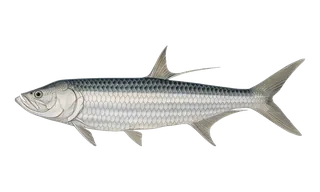 Tarpon — Summer only — soak big live menhaden on circle hooks at the inlet drop-offs on the moon tides.Gear9/0–10/0 circle hooks80 lb fluorocarbon leaderBait cast net
How to ID
- Large bright silver scales (silver-plated look)
- Single dorsal fin with a long trailing filament at the rear
- Large upturned (superior) mouth, bony upturned lower jaw
- Big eyes; deeply forked tail
- No spots, scutes, or barbels
Typical: 48–72 in, 60–130 lb
Tell it apart: Huge silver-dollar scales and a long trailing filament off the back of the dorsal fin make the tarpon unmistakable.
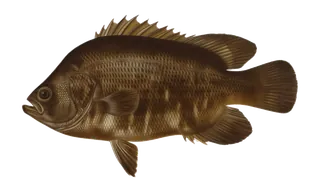 Tripletail — Late spring through summer — idle markers and crab-pot buoys, spot the fish, and pitch a live shrimp under a cork past it.GearPopping corks1/0–2/0 Kahle hooksInshore spinning combo
How to ID
- Dark brown to mottled yellow-olive body
- Rounded dorsal and anal fins set far back, giving a three-tailed look
- Compressed, deep, perch-like body
- Concave (dished) forehead profile
- Often seen floating on its side near structure/flotsam
Typical: 18–26 in, 5–15 lb
Tell it apart: Rounded dorsal and anal fins positioned far back near the tail create the trademark 'three-tail' silhouette that names the fish.
Nearshore
- Spanish Mackerel — Spring through fall — troll small Clarkspoons fast behind a planer, or cast metal into diving birds.GearClarkspoon trolling spoonsNo. 1–2 trolling planersGotcha casting plugs
How to ID
- Greenish back, silver sides with round golden-yellow spots (no stripes)
- Front third of first dorsal fin jet black
- Lateral line slopes gently to the tail, no abrupt dip
- Forked tail; row of finlets behind dorsal and anal fins
- Adults rarely exceed a few pounds (much smaller than king)
Typical: 14–22 in, 1–3 lb
Tell it apart: Golden-yellow oval spots plus a black front patch on the first dorsal fin and an evenly sloping lateral line separate Spanish from the spot-poor king mackerel.
Easily confused with: King Mackerel, Bonito / FA
- King Mackerel — Late spring through fall — slow-troll live menhaden or cigar minnows on wire stinger rigs 5–15 mi out.GearKing mackerel stinger rigsSea-witch trolling skirtsCoated wire leader
How to ID
- Steel-blue back, silver sides; adults lack spots
- Lateral line drops sharply downward below the second dorsal fin
- First dorsal fin uniformly pale (no black front patch); folds into a groove
- Slender elongate body, deeply forked tail
- Row of finlets behind dorsal and anal fins
- Juveniles may show faint yellow spots
Typical: 24–40 in, 8–20 lb
Tell it apart: The sharp downward dip in the lateral line under the second dorsal, plus a pale (not black-fronted) first dorsal fin, marks a king mackerel.
Easily confused with: Spanish Mackerel, Wahoo
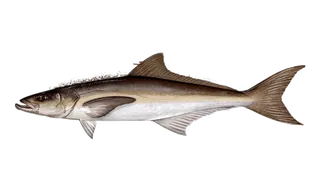 Cobia — The spring run (Apr–May) — run the beach in 10–30 ft on calm days and sight-cast a bucktail to fish on rays and pods.GearCobia bucktail jigsSoft-plastic eel luresHeavy spinning combo
How to ID
- Long, broad, flattened head; dark brown back
- Single horizontal dark stripe with paler band above and below
- Row of 7-9 short, stout, separate spines ahead of the dorsal fin (no connecting membrane)
- Broad shark/remora-like head with projecting lower jaw
- White belly; broad, slightly forked tail
Typical: 30–45 in, 15–40 lb
Tell it apart: A brown lateral stripe on a flat-headed, remora-like body with low isolated dorsal spines identifies cobia (often mistaken at a glance for a shark, which has gill slits and rough denticle skin).
Easily confused with: Sharks
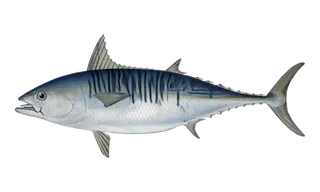 Bonito / FA — Spring and fall pushes — race to busting bait and birds, then burn a fast-sinking metal or epoxy jig through the school.GearEpoxy jigsCasting metal lures30 lb fluorocarbon leader
How to ID
- Football-shaped, steel-blue back; corselet of larger scales over the chest
- Atlantic bonito: straight dark oblique stripes running onto the upper back
- Little tunny (false albacore): wavy/wormlike markings confined to the back above the lateral line, plus 3-7 dark fingerprint spots between the pectoral and pelvic fins
- Belly otherwise silvery; small mouth with fine teeth
- Deeply forked tail; row of finlets
Typical: 20–32 in, 6–18 lb
Tell it apart: Back stripes/wavy marks over a largely clean belly (with little tunny's fingerprint spots) separate bonito/false albacore from the round-yellow-spotted Spanish mackerel and the deeper-bodied blackfin tuna.
Easily confused with: Spanish Mackerel, Blackfin Tuna
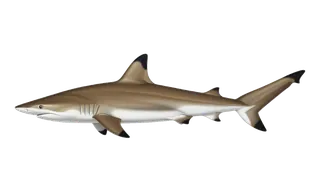
- Sharks — Warm months — anchor up-current of an inlet, send an oily cut bait down a chum slick on wire; circle hooks for a clean release.GearWire shark leaders10/0+ circle hooksHeavy boat combo
How to ID
- Cartilaginous body, 5-7 gill slits on each side (no gill cover)
- Rough sandpaper skin (dermal denticles), no true scales
- Heterocercal tail with longer upper lobe
- Mouth set under the snout (ventral)
- Multiple rows of replaceable teeth
- Rigid fins that do not fold into grooves
Typical: 2.5–6 ft, 10–90 lb
Tell it apart: Open gill slits and rough denticle skin confirm a shark; common SE species split by snout/teeth: blacktip (black fin tips), bonnethead (shovel head), Atlantic sharpnose (white-spotted with white fin edges).
Easily confused with: Cobia
Offshore
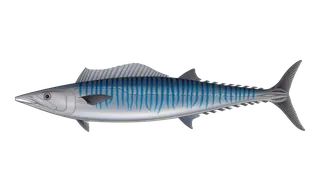 Wahoo — Late fall through winter — high-speed troll 12–18 kt with weighted Ilander or jet heads on wire leader.GearIlander-style trolling luresSingle-strand wire leaderOffshore trolling combo
How to ID
- Long, slender, torpedo body; iridescent blue-gray with vivid blue vertical bars
- Long beak-like snout with razor triangular teeth
- Tall first dorsal fin running most of the back
- Deeply forked tail, row of finlets
- Hinged jaw that folds; skin appears nearly scaleless
Typical: 40–60 in, 20–50 lb
Tell it apart: Vivid electric-blue vertical bars and a long razor-toothed beak separate wahoo from the unbarred, spot-free king mackerel.
Easily confused with: King Mackerel
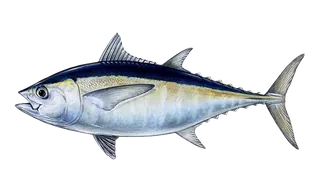
- Blackfin Tuna — Best in the cooler months — vertical-jig or live-bait the Snapper Banks ledges at first light.GearVertical speed jigs8/0 circle hooks50 lb fluorocarbon leader
How to ID
- Dark blue-black back, silver sides; deep football body with a chest corselet
- Finlets dusky/black, edged white-gray (NOT bright yellow as in other tunas)
- Short pectoral fins, not reaching past the second dorsal origin
- Smallest tuna; no oblique back stripes or fingerprint belly spots
- Faint yellow on the central finlets at most
Typical: 20–28 in, 5–20 lb
Tell it apart: Dark finlets lacking bright yellow, on a deep football body with no back stripes, separate blackfin from the back-striped, fingerprint-spotted bonito/false albacore.
Easily confused with: Bonito / FA
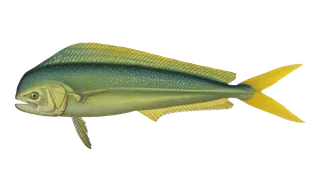 Mahi (Dolphin) — Late spring into summer — hunt weed lines, color changes and birds 30–60 mi out, then pitch ballyhoo or jigs to the school.GearTrolling skirt lures6/0 circle hooksOffshore spinning combo
How to ID
- Brilliant green-gold-blue with iridescent spots, fading after death
- Long-based dorsal fin running nearly head to tail
- Squared, blunt forehead in adult males (bulls); rounded in females
- Deeply forked bright-yellow tail
- Compressed body, single long-based anal fin
Typical: 24–40 in, 5–25 lb
Tell it apart: A single long dorsal fin spanning almost the whole back over a brilliant green-and-gold body is diagnostic of mahi.
- Sailfish — Spring and fall peaks — slow-troll or kite live baits along the break, or pull a dredge-and-ballyhoo spread; circle hooks for clean releases.GearBallyhoo rigging kit6/0–7/0 circle hooks60 lb fluorocarbon leader
How to ID
- Huge sail-like first dorsal fin, far taller than the body is deep
- Long spear-like upper bill (rounded in cross-section)
- Cobalt blue back, silver sides with rows of pale blue spots/bars
- Slender body; very long, thin pelvic fins
- Two keels on each side of the tail base (billfish family)
Typical: 6–7 ft, 30–50 lb
Tell it apart: The enormous sail-shaped dorsal fin, taller than the body's depth, instantly separates sailfish from the lower-finned marlins (keel count is shared by both, so use the fin).
Easily confused with: Marlin
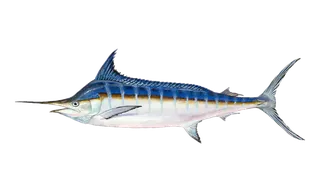 Marlin — A summer fishery — pull big skirted lures and rigged ballyhoo at 7–9 kt along blue-water temperature breaks.GearMarlin trolling luresHeavy trolling comboHeavy mono leader
How to ID
- Stout, round-sectioned bill (spear)
- Pointed, stiff first dorsal fin lower than body depth (blue marlin)
- Cobalt/blue-black back, silver-white belly
- Often pale blue vertical bars on the flanks
- Two keels on each side of the tail base
- High shoulder, heavy body
Typical: 8–11 ft, 150–400 lb
Tell it apart: A pointed first dorsal fin shorter than the body is deep marks a marlin, versus the sailfish's towering full-length sail.
Easily confused with: Sailfish
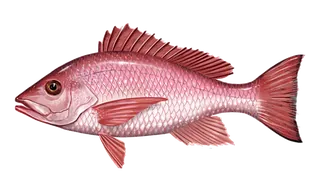 Red Snapper* — A very short federal season (mid-summer) — drop cut bait or pinfish on a knocker rig over live bottom and ledges.GearKnocker rigs7/0–9/0 circle hooksBottom / deep-drop combo
How to ID
- Uniform brick-red to rosy body, red iris
- Sloping forehead and pointed snout
- Anal fin pointed/angular (not rounded)
- Enlarged canine teeth in the jaws; large mouth
- Tail only slightly forked; juveniles show a dark spot high on the side that fades with age
Typical: 16–28 in, 3–12 lb
Tell it apart: A red eye, angular anal fin, canine teeth and a barely forked tail separate the larger red snapper from the small-mouthed, deeply-forked-tailed vermilion.
Easily confused with: Vermilion / B-sea
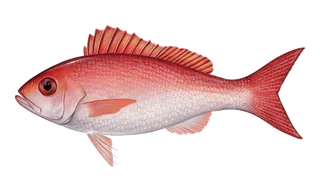
- Vermilion / B-sea — Year-round bottom fishing — multi-hook rigs with small squid or cut strips on the ledges and Snapper Banks.GearMulti-hook bottom rigsSquid bait stripsBottom fishing combo
How to ID
- Vermilion/red back fading to silvery-pink sides
- Large yellow-gold eye relative to a small mouth
- Faint yellow streaks/dashes along the upper sides
- Rounded anal fin; no enlarged canine teeth
- Deeply forked tail; smaller, more slender body than red snapper
Typical: 12–18 in, 1–3 lb
Tell it apart: A proportionally large eye over a tiny mouth, a rounded anal fin and a deeply forked tail flag a vermilion (beeliner) versus the canine-toothed, red-eyed, barely-forked red snapper.
Easily confused with: Red Snapper*
Fishing Regulations
Tides & Timing
Read the Tide
Big 6–9 ft tide swings drive the bite — fish the last of the falling and first of the rising, and watch wind-against-tide at the inlets.
Other towns in the Southeast Atlantic
Beaufort, SC · Brunswick, GA · Charleston, SC · Fernandina Beach, FL · Hatteras, NC · Jacksonville, FL · Morehead City, NC · Murrells Inlet, SC · St. Augustine, FL · St. Marys, GA · Tybee Island, GA · Wrightsville Beach, NC